Occasional blogging, mostly of the long-form variety.
Showing posts with label Media Reform. Show all posts

Sunday, December 22, 2019

Bred for Circuses

Conservatives and Republicans can win few arguments honestly on the merits; most of their policies are awful for the vast majority of Americans and benefit only a select few, typically the rich and powerful. Conservative positions tend to be unpopular, too. Rather than change their policies, conservatives choose to lie constantly and shamelessly, and to stoke the worst impulses of their base. Key to these dynamics is ignoring matters of truth and fact, as well as any serious discussion of greater principles about how our country should work. Instead, they try to reduce everything to my team against your team, us against them. The Republican Party is aided in this by a large block of rabid, authoritarian conservatives and a propaganda network eager to feed the faithful the latest two minutes hate, 24/7. Outsized media personas play a critical role in this strategy. ("Conservative" and "Republican" are pretty interchangeable in this post, but for more on that, see the first link above.)

Conservatives and Republicans are also aided, however, by shallow political coverage by mainstream media outlets that far too often withhold essential context from their audiences by refusing to fact check or call out lies, by pretending policy doesn't matter, by pretending both major American political parties are basically the same and both sides are equally to blame for our political problems, and that any deeper look is pointless and/or partisan. Shallow coverage is cheaper to produce and avoids offending some viewers (while aggravating others), and is also seen as neutral and savvy by some reporters. Unfortunately, it's lousy for informing citizens and thus bad for democracy. Propaganda typically demonizes the perceived opposition unfairly, whereas shallow political coverage is loath to call out even clear wrongdoing or hypocrisy by one party. Thus both lying and gutlessness reduce the national political discourse to superficial, bad sports coverage of two competing political teams and to treating important matters as mere entertainment, a sitcom, a circus.

We've seen all these dynamics play out in the impeachment hearings on Donald Trump, related press conferences and media coverage of all of it. During the impeachment hearings in the House of Representatives, several observers noted that Republicans seemed less interested in making coherent arguments or convincing the general populace of their cause than creating video clips for Fox News to run for the conservative base. After the hearings moved from the intelligence committee chaired by Representative Adam Schiff (D-CA) to the judiciary committee, Republicans pulled the stunt of putting Schiff on a milk carton poster, saying he was missing because he rejected their call to appear as a witness. (Republicans also asked to call the anonymous whistleblower yet again.) Schiff rejected the request, instead pointing to the intelligence committee's 300-page report and the evidence it covered, and added:

There is nothing to testify about. I think if the President or his allies in the Senate persist it means they are not serious about what they are doing. What would I offer in terms of testimony, that I heard Dr. [Fiona] Hill in open hearing say such and such? That is not pertinent. The only reason for them to go through with this is to mollify the President and that is not a good reason to try to call a member of Congress as a witness.


Trump has repeatedly, angrily expressed a desire to prosecute Schiff for paraphrasing him, but has run into the small problems that that's not illegal and Trump is not a dictator. Judiciary chair Jerold Nadler (D-NY) unsurprisingly sided with Schiff about testifying, and in his letter to Republicans, Nadler cited the "independent evidence" for the conclusions of the report and issues initially raised by the whistleblower. Nadler also reiterated for the umpteenth time concerns about witness intimidation and threats of retaliation by Trump and other conservatives against the whistleblower. As for the report itself, Professor Heather Cox Richardson, who's delivered excellent analysis on the impeachment hearings and related stories, offered up a nice summary on 12/3/19:

The big news today was that the House Intelligence Committee released its report on its investigation into the Ukraine scandal that is at the heart of the impeachment case against Trump. Although the report was long, it had two very clear points: the facts against Trump prove that he solicited a bribe—wording designed to show that the scandal meets the Constitution’s threshold for impeachment—and that Trump obstructed justice in his attempts to stonewall Congress and intimidate witnesses. Obstruction of justice is a crime; it is what took Nixon down in 1974.

The report lays out that the Ukraine scandal is at heart an attempt to rig the 2020 election and destroy our democracy with the help of a foreign country. It points out that this is a pattern for Trump, who benefited from Russian aid in 2016 and who has openly called for help from China as well as Ukraine before the upcoming election. The report notes that Trump’s call with Zelensky took place the day after Special Counsel Robert Mueller testified in public, apparently convincing Trump he was no longer in danger of being nabbed for working with Russia in 2016, and was willing to try a similar scheme again.

The report also notes that the Founders worried about precisely this behavior, and that if it is not checked, democracy is over. The House Intelligence Committee report is a remarkably clear, concise, and powerful document.

For their part, the White House ignored all the facts and relied instead on disinformation. . . .


These are grave matters, but Republicans do not want to discuss the facts and principles driving all serious discussions of impeachment. Likewise, Republicans showed little interest that intelligence committee ranking member Devin Nunes (R-CA), who led the Trump defense in the first set of impeachment hearings, allegedly was part of the Ukraine scandal himself to some degree. As of late November, Republicans had offered at least 22 excuses for Trump (or by another count, 64), many of them contradictory. This blunderbuss technique is a reliable sign of bullshitting and bad faith. Similarly, the Republicans' competing impeachment report "is a series of red herrings." (As of this writing, the House has impeached Trump, and Senate Majority Leader Mitch McConnell (R-KY) has vowed to coordinate with the White House during any trial in the Senate, further suggestion that the fix is in and the Republican-majority Senate will not convict Trump, regardless of the merits of the charges.) Meanwhile, Trump's unhinged letter to Nancy Pelosi frames the entire impeachment process as driven by a personal vendetta against Trump, not the serious matter of upholding core principles of the U.S. Constitution that it is. Trump's conceit is that Schiff, Pelosi, and every single person who's said something critical of him, given factual evidence harmful to him or moved to curtail his power simply dislikes him personally versus, say, being motivated to uphold the rule of law and think of the good of the country and other higher principles. Trump and the Republicans cannot win an honest, substantive discussion. So they need to reduce everything to: Their guy doesn't like our guy. Just because he's our guy. Fight for our guy. Fight for the team. Attack the enemy.

These dynamics are not remotely new, even if they've become more prevalent not just in politician's arguments but in the political coverage itself. Back in 2006, linguist Geoffrey Nunberg discussed the theatricality of political commentary, even comparing the choice of political talk show figures to sitcom casting. This was back when Ann Coulter was arguably at the nadir of her awfulness, selling shock value and viciousness, and getting plenty of coverage from mainstream media outlets in addition to her usual support from Fox News and other conservative entities. What Nunberg describes as political "smut" overlaps with behavior we might now call trolling, and Coulter was one of the most successful practitioners at the time:

Take Ann Coulter's recent description of the 9/11 widows as self-obsessed witches who were enjoying their husbands' deaths. As calumnies go, it doesn't have a patch on the things people were saying in the 1864 election, when the Democrats called Lincoln a leering buffoon, and Horace Greeley accused the Democrats of stealing the votes of dead Union soldiers. But it's only in the current age that remarks like those could turn someone into a media celebrity who's invited to appear on Jay Leno and the Today Show to repeat her choicest remarks for the delectation or outrage of their viewers.

Coulter's celebrity is a good measure of what has become of political discussion. You'd scarcely describe her as a political thinker, no more than you'd describe Simon Cowell as an critic of the arts. But like Cowell, she has an unerring gift for media theatrics. It isn't just her penchant for making snarky or outrageous remarks. Plenty of people do that without being invited onto the Today Show, and in fact Coulter doesn't get a lot of national attention for her run-of-the-mill ruminations about giving rat poison to Justice Stevens or fragging John Murtha. But the remark about the 9/11 widows was irresistible for its brazen and gratuitous tastelessness and the obvious pleasure Coulter took in consternation she created.

Is Coulter is sincere about the things she says? That's a silly question, like asking whether schoolchildren are sincere in the taunts they throw at each other across the school yard. But that doesn't make her a satirist, as her defenders like to claim -- usually with the implication that her literal-minded liberal critics don't get the joke.

Satire depicts things as grotesque in order to make them seem ridiculous -- what Stephen Colbert does in his Bill O'Reilly persona or Christopher Buckley does with the pointed caricatures of Thank You For Smoking. But Coulter isn't actually sending anybody up -- not herself, certainly, and not the targets of her remarks. Her fans may enjoy hearing her talk about poisoning Justice Stevens or say that it's a pity Timothy McVeigh didn't park his truck next to the New York Times building. But that's not because the remarks make either Stevens or New York Times seem particularly ridiculous. It's because Coulter seems to be able to get away with unbridled aggression by presenting it as mere mischief, leaving her critics looking prim and humorless. ("Perhaps her book should have been called 'Heartless,'" said Hillary Clinton after Coulter's remarks about the widows, inviting the response, "Oh lighten up, girl.")

That rhetorical maneuver doesn't really have a name, but it's a close relative of what we think of as smut. In the strict sense, of course, smut is the leering innuendo that veils sexual aggression. But in a broader sense, smut can be any kind of malice that pretends to be mere naughtiness. It might be a leering vulgarity, a racial epithet, or simply a venomous insult -- what makes it smut is that it's tricked out as humor, so that if anyone claims to be offended you can answer indignantly, "Can't you take a joke?"

In that broad sense, smut can sometimes be innocuous fun. It's a staple of sitcoms, in what you could think of as a Wooo! moment. That's the moment when a character who's comically malicious or catty (think Betty White, Rhea Perlman, Joseph Marcell) makes a remark that's just offensive or risqué enough to brush the limits of taste, and the studio audience reacts by saying "Woooo!!"

The political talk shows traffic in these moments, too -- not surprising, considering how much those shows owe to the classic sitcom. When you think of the most successful practitioners of the genre, whether Coulter, O'Reilly, or James Carville, there isn't a one of them who couldn't be the model for a recurring character on Cheers or Drew Carey -- the waspish virago, the bombastic blowhard, the sly yokel.

And as on the sitcoms, the drama of the political talk show is character-driven rather than plot-driven. Watching O'Reilly or Hannity and Colmes, you can't help recalling the bickering on All in the Family, where politics was always just a pretext for the clash of personalities. It doesn't matter whether the ostensible issue is the massacre at Haditha or an increase in wild bachelorette parties; it's going to be reduced to grist for the eternal squabble between liberals and conservatives -- not as adherents of opposing political philosophies, but more as distinctive political genders. ("Who are these parents who allow their kids to sleep with Michael Jackson?," Alan Colmes asked a couple of years back, and Sean Hannity answered, "Liberals.")


Coulter and Trump share a great deal in terms of a bullying style, but also in their knack for nabbing mainstream coverage and validation, in large part by crafting a character to sell, a media persona. (Coulter thankfully gets less attention these days. Incidentally, Coulter has criticized Trump for not building a border wall and not being harsh enough on immigration, but says she will vote for him anyway. My most in-depth post on Coulter is this one, although some links are broken.) Coulter, like many conservative political commentators, has always been light on substance or outright rejects it. Instead, the key selling point for such figures has always been viciousness and 'owning the libs,' to the delight of their audience. Coulter is now a less popular conservative belligerent than, say, Sean Hannity, Tucker Carlson, Mark Levin, Alex Jones, Glenn Beck, Sarah Palin, Tomi Lahren and perennial ragemonger Rush Limbaugh (among others), but currently, they're all eclipsed by the biggest conservative troll of them all, Donald Trump.

As we've covered before, Trump's main selling point to the conservative base is spite; he promises to hurt the people they fear and dislike. He's a bigot, and racism and bigotry form a key part of his appeal to his fans. The recording of him bragging about sexual assault did not sink his presidential campaign and at least 25 women have accused him of sexual misconduct. Trump constantly lies; as of October 2019, he'd told at least 13,435 false or misleading claims over 993 days. In 2016 shortly after being elected, Trump paid $25 million to settle fraud cases against Trump University, a business that one of its own employees described as "a fraudulent scheme." Trump also recently paid a $2 million settlement for using charity funds supposedly going to military veterans for personal use instead, including buying a portrait of himself. (Grifting runs in the family; son Eric Trump's charity misused funds meant to go to St. Jude's Children's Research Hospital, which predominantly serves kids with cancer.) Imagine the conservative outrage if Barack Obama or really any Democrat had done a fraction of this, yet most of them give Trump a pass.

Trump's image as a successful businessman is an utter fiction constructed by Trump himself, aided by his late father and by fawning media coverage. He's not a business genius, or even a competent businessman – he just plays one on TV. As The New York Times reported in 2016:

[Trump's] casino companies made four trips to bankruptcy court, each time persuading bondholders to accept less money rather than be wiped out. But the companies repeatedly added more expensive debt and returned to the court for protection from lenders. . . .

All the while, Mr. Trump received copious amounts for himself, with the help of a compliant board. In one instance, The Times found, Mr. Trump pulled more than $1 million from his failing public company, describing the transaction in securities filings in ways that may have been illegal, according to legal experts.


In 2018, The New York Times further reported that rather than being largely a self-made man, Trump inherited at least $413 million from his father, and his entire family has enriched itself with possibly illegal schemes. In 2019, the Times reported that Trump lost over a billion dollars over a decade, losing more money than any other individual in the United States in that time period while simultaneously selling himself as a great dealmaker. Trump's retorts to these reports were unconvincing; as The New Yorker's John Cassidy put it, Trump stands revealed as the biggest loser. Trump's dealings with Deutsche Bank further undermine any claims of actual business acumen versus his ability to scam lenders. Trump may not actually be a billionaire and almost certainly has less money than he pretends, but nonetheless, he'd have more money if he had simply invested in the stock market than attempted all his deals. (As people have joked, Trump has lost money selling booze, steaks and gambling to Americans. Who does that?)

Conservatives sure love their macho daddy figures, from those fake cowboys, Ronald Reagan and George W. Bush, to that fake, successful businessman, Donald Trump. The book The Art of the Deal played a critical role in selling the myth of Trump, but its deeply regretful ghostwriter Tony Schwartz has explained how he made Trump appear far more thoughtful, competent and ethical than he actually is. The Art of the Deal in turn helped Trump get an even larger vehicle for mythmaking, the NBC TV show, The Apprentice. As The New Yorker article "How Mark Burnett Resurrected Donald Trump As an Icon of American Success" explains:

"The Apprentice" portrayed Trump not as a skeezy hustler who huddles with local mobsters but as a plutocrat with impeccable business instincts and unparalleled wealth—a titan who always seemed to be climbing out of helicopters or into limousines. “Most of us knew he was a fake," [producer Jonathon] Braun told me. "He had just gone through I don’t know how many bankruptcies. But we made him out to be the most important person in the world. It was like making the court jester the king." Bill Pruitt, another producer, recalled, "We walked through the offices and saw chipped furniture. We saw a crumbling empire at every turn. Our job was to make it seem otherwise."


(For more on the mythic Trump created on The Apprentice, see The New Yorker again, The New York Times, Fortune and People's piece on Fisher Stevens' documentary on Trump, The Confidence Man.)

Donald Trump is probably one of the worst businessmen in human history and also possibly the most successful con man. His image as a great businessman and dealmaker is a complete fraud. About the only authentic things about him are his vanity, bigotry, greed, proud ignorance and spite. Yet the conservative base loves him and congressional Republicans loyally defend him despite any misgivings.

Mainstream media outlets have often struggled to cover Trump, as well as conservative and Republican perfidy in general. In contrast to some of the excellent investigative journalism mentioned above, daily news coverage of political clashes often descends to a "he said, she said" level. For example, Dan Froomkin's piece criticizing a New York Times article on impeachment is aptly titled, "In the war on truth, the press can't be an innocent bystander." Fact-checking and calling out liars is essential, but often doesn't occur. Likewise, as we've mentioned before, "coverage on the 2016 presidential race almost entirely ignored policy issues and focused on shallow issues with false balance." Such coverage decisions help candidates with bad positions, slim policy portfolios or a habit of lying. False equivalencies and "both siderism" also remain persistent scourges to good journalism, but rather than delve into that here, I'll once again link past posts by digby, driftglass, alicublog, Balloon Juice, LGM and my own archives.

Consider entertainment programming – and news sold as entertainment – and the picture grows even worse. NBC created The Apprentice and played a central role in creating the myth of Trump that enabled him not only to run for president but win. NBC also let Trump host Saturday Night Live even after cutting ties with him over bigoted comments. And NBC and other mainstream outlets have long validated Trump and earlier toxic figures such as Ann Coulter. Trump received more than $5.9 billion of free media coverage during the election, over twice the amount received by Hillary Clinton. In 2016, then-CBS chairman Les Moonves made some infamous remarks about the "circus":

Donald Trump’s candidacy might not be making America great, CBS Chairman Les Moonves said Monday, but it’s great for his company.

"It may not be good for America, but it's damn good for CBS," Moonves said at the Morgan Stanley Technology, Media & Telecom Conference in San Francisco, according to The Hollywood Reporter — perfectly distilling what media critics have long suspected was motivating the round-the-clock coverage of Trump's presidential bid.

"Most of the ads are not about issues. They're sort of like the debates," Moonves said, noting, "[t]here's a lot of money in the marketplace."

The 2016 campaign is a "circus," he remarked, but "Donald's place in this election is a good thing."


Moonves' later claim that he was joking was unconvincing. Trump was a horrible candidate who frequently behaved vilely, but he was a showman, so CBS, NBC, and other outlets gave Trump tons of coverage, some negative, but not really that critical, and certainly not substantive, given their scant discussion of policy. They rejected sound editorial judgment and shamefully if predictably chose short-term profits over a sense of civic duty to meaningfully inform their audiences, especially because they thought Clinton would win and their behavior could not affect the election. But it most certainly did.

Worse than the mainstream outlets, though, are propaganda outlets, most notably Fox News. Fox News has always scored poorly in terms of factual accuracy, but it's moved beyond being a conservative news outlet to being outright propaganda, comfortable to flat-out lie. The same is true of Republicans in government, and the two work closely together. See, for example, Jane Mayer in The New Yorker on "The Making of the Fox News White House" and Greg Sargent in The Washington Post on how "McConnell’s awful Hannity interview shows power of Fox News’s disinformation." In a similar vein, The Post reported, "A Justice Department inspector general’s report examining the FBI investigation of President Trump’s 2016 campaign rebutted conservatives’ accusations that top FBI officials were driven by political bias to illegally spy on Trump advisers but also found broad and “serious performance failures” requiring major changes." Attorney General William Barr, a Republican party loyalist, has undercut his own department and directly contradicted key findings of the report, as covered in Sargent's piece, "William Barr’s deceptions are more dangerous than you think" and Wonkette's "Just When You Thought You Couldn't Respect Bill Barr Any Less." Wired covered Barr and much more in "Fox News Is Now a Threat to National Security." Digby's commented on similar dynamics in "The Nonsense Ecosystem" (adopting a phrase from Daniel Dale) and many other posts. Fox News and the entire right-wing media ecosystem pose a serious and growing problem to democracy. As several people have noted, if Nixon had had Fox News, he might not have been impeached.

Authoritarian conservatism plays a pivotal role in making the propaganda work; Fox News and similar outlets cater to an audience eager to hate their scapegoats du jour. In 2016, then-candidate Trump bragged that "I could stand in the middle of 5th Avenue and shoot somebody and I wouldn't lose any voters." He considered it praise for his supporters' loyalty; it was instead an accurate and chilling description of unquestioning obedience and authoritarianism (and Trump's megalomania). One of Trump's lawyers has actually argued in court that as president, Trump could indeed shoot someone in 5th Avenue and get away with it (shades of Bush lawyer John Yoo). The transcript of Trump's call with Ukrainian President Zelensky is damning, especially with the added context that has been provided by later reporting and the impeachment hearings. Yet Trump and his allies have shouted to "READ THE TRANSCRIPT!" as if it exonerates him. Trump even held a rally where supporters were wearing t-shirts (presumably distributed by Trump's team) saying "READ THE TRANSCRIPT!" Naturally, as The Daily Show discovered in a great segment covering a later rally, most Trump supporters have not read the transcript and were not familiar with the key takeaways, even though some said – without irony or self-awareness – that reading the transcript, not being a sheep and being an independent thinker were all important. They simply believe what they're told, and do so gladly it's from the right authority figures, whether that's Trump himself, Fox News talking heads or other conservative figures. It's completely Orwellian; they will eagerly believe that black is white and insist that their chosen political team is always in the right. (Who are you going to believe, Trump and Fox News or your lying eyes?)

Trump was clearly unfit for office before the election and has provided overwhelming evidence of his unfitness since. The misdeeds for which he's being impeached may not even be the worst things he's done (and who knows what else will come out), but they're certainly sufficient grounds for removing him from office. The conservative base, Republican voters and congressional Republicans simply do not care. Nearly 90% of self-described Republicans voted for Trump in 2016, and assuming he's still in office by the time of the 2020 election, similar percentages will likely vote for him again, despite any disapproval they express. As of this writing, Trump has been impeached but the articles of impeachment have not been sent to the Senate. The Democratic presidential candidate for 2020 has not been chosen and the presidential election has not occurred. Despite some uncertainties about the year(s) ahead, we can make some reasonable predictions, among them that conservatives and Republicans will not behave honorably and it would be folly to expect otherwise.

Conservatives tend to be bullies with power and whiners without it. They've constructed alternative realities with alternative facts, where they can believe what they want and feel simultaneously persecuted (and thus righteously aggrieved) and superior. Some religious conservatives (ostensibly Christian) will even cite ancient Roman persecution of Christians, that they were thrown to lions in the arena. There's some truth but mostly myth to that tale, but regardless, some religious conservatives will apocalyptically invoke the image as a future reality should "socialism" take hold (via a Bernie Sanders presidency, for instance). The truth is that conservatives thrill for combat with their chosen foes, and that they'd just choose new scapegoats if they ever succeeded in eliminating the old ones. They don't believe in treating others as they would like be treated, and certainly don't believe in turning the other cheek. They are pro-spectacle, anti-substance, pro-circus; authoritarian conservatives are particularly bred for circuses. They don't truly object to the idea of throwing people to the lions; they just want the power to choose the victims.

(Cross-posted at Hullabaloo.)

Sunday, August 17, 2014

Artificially Equalizing Unequal Views on Inequality

The mainstream political press has a horrible tendency to rely on false equivalencies and to conclude, far too simplistically and without nuance or detail, that 'both sides are equally to blame.' It would take much more effort, and seem like taking sides, to call things accurately to the best of their ability, or discuss policy positions in terms of facts and likely outcomes, or contextualize negotiations and other matters for their audience. Even important issues can wind up being poorly covered. Some conclusions, no matter how well supported, are deemed unacceptable; others are essentially predetermined, regardless of the pesky facts. A Washington Post piece from July provides a good example.

The Article

"A think tank wanted to study inequality. It couldn’t get conservatives on board" by Jim Tankersley covers an interesting tidbit. (Its subtitle, "If most of the research on a big economic question comes from one political point of view, can Americans trust it?" seems like an awfully loaded and misleading question, however. To be fair, editors often choose the headlines, not the authors – but Tankersley is listed as the editor for this and other "Storyline" pieces.)

The setup—a new Beltway think tank (Washington Center for Equitable Growth) wants to study an important issue:

What she wanted, [Heather] Boushey said, was to fund an intellectually honest investigation of arguably the hottest issue in American economics right now: the widening gap between the richest Americans and everyone else. She wanted to learn more how and why that gap might hurt the nation’s overall economic performance.

The think tank has some members with a liberal background, but apparently it aims to be inclusive and is officially "non-partisan." Accordingly, it extends a wide invitation:

Boushey was hoping to sign up an ideologically diverse cross-section of thinkers to her effort. . . .

The grant recipients, she explained, would examine questions of inequality and growth from every possible angle, liberal and conservative. They’d report what was true and what wasn’t. Her think tank would live with the findings, whatever they might be.

The think tank's trying to be inclusive and strives to be empirical and data-driven. Sounds good so far. Next, proposals are submitted and grants are given:

There are no identifiably conservative economists among the grantees, however.

Uh-oh! That doesn't sound inclusive! What gives?

No conservative economists applied for grants, among the 70 submissions the center received, Boushey said.

...Oh. Well, it's rather hard to offer a grant to someone who can't even be bothered to apply. Not even one of the 70 applicants was a conservative? That seems remarkable. Why was this? Tankersley theorizes:

Perhaps that’s because the center has, in its early months of existence, engaged in some high-profile blog-and-social-media fights with conservatives over questions of data and policy when it comes to inequality.

Alas, no links are provided for this. This sounds a bit whiny, that the new think tank was mean, so conservatives didn't want to play. The think tank's twitter feed seems fairly anodyne and not combative. Back in May, Boushey did appear on PBS' NewsHour to debate Kevin Hassett of the conservative American Enterprise Institute (AEI) about Thomas Piketty’s recent book, Capital in the 21st Century, but it's a pretty polite exchange of disagreements. The most charitable possibility (for conservatives) would be that they judged that their contributions would be unwelcome. (It's a paid gig, though. And wouldn't getting paid to skewer a liberal position be tempting?) But Tankersley's speculating anyway, so let's move on. He floats another idea:

Perhaps it’s because it’s relatively rare in Washington for liberal and conservative thinkers to team up to pursue big questions – especially ones that, depending on the answer, could shake party platforms or basic ideological beliefs.

This is a much more convincing hypothesis, especially if one's familiar with the usual conservative stances on inequality. Tankersley continues:

It’s also true, in this case, that a lot of conservative economists have already decided that inequality – as opposed to mobility or the even broader “economic opportunity” – isn’t a problem.

Aha! Yes, this is much stronger, more accurate stuff – conservatives have often stated that inequality is overstated, or that it isn't a problem, or that efforts to ameliorate it cause more harm than good, or all of the above. Tankersley's link is to conservative AEI and its latest 117-page collection of essays, which argue all of these positions. This is good context for the reader.

This is the real challenge posed faced by Boushey, and her center, and the work that will now begin thanks to their grants: If most of the research into an economic issue is being conducted from one side of a political debate, consumers of that research could – and should – look skeptically on its conclusions, until persuaded otherwise. The burden is on the researchers, on their data and the stories they tell from it.

It’s a heavy burden. It would help to have a more diverse group of thinkers shouldering it.

Umm… what? Where did this come from? How does this follow? And a "diverse group" needs to include people who explicitly don't want to study the issue? I suppose "until persuaded otherwise" and the mention of "data" soften this a bit, but this is quite the sharp turn. It also ignores that there's a great deal of solid research on inequality already. For example, Thomas Piketty's aforementioned book, Capital in the 21st Century, is a new, major work in the field, and it's earned praise for its extensive research and synthesis of previous studies. (It's also received plenty of attacks from conservative outlets.) This think tank story, and discussions about inequality in general, do not take place in a vacuum. Let's recap Tankersley's account and conclusion:

1. A think tank wants to study inequality. It invites conservatives to participate.

2. Conservatives completely decline to participate (zero of seventy applicants).

3. It's mentioned but isn't emphasized in the piece that the think tank is sponsoring data-driven work. (A chart of the grantees and their paper topics is included. The findings of previous major studies on inequality are not mentioned.)

4. The conservative position is that inequality doesn't matter. (It's not really explored that justifications for this tend to be ideological versus data-driven. More on this in a bit.)

5. Conservatives have their own think tanks upholding their position.

6. Somehow… the new think tank's conclusions will be suspect and the burden is on its members, despite conservatives rejecting their invitation and rejecting their entire endeavor (not to mention rejecting the findings of previous studies).

Tankersley sure seems to arguing that if conservatives don’t agree with something, it can't be valid (or at the very least, that it must be viewed with great suspicion). There are several glaring problems here.

It's completely reasonable and fair to let different political factions have their say. It's utterly ridiculous, however, to automatically judge that their positions are equally valid and sound – especially when the facts say otherwise. Serious policy discussions require some level of qualitative analysis and judgment. Tankersley offers a variation on the usual predetermined "both sides are equally to blame" conclusion – in this case, he essentially lets conservatives veto the propositions that inequality matters and that it should be studied. He doesn’t provide much context for the reader, but essentially, he's falsely equating an empirical approach (and extensive data from it) by one "side" in a debate with a conservative ideological position against it. (For instance, conservatives will indeed argue that efforts to lessen inequality are ineffective or counterproductive, but their central, much more common argument is that such efforts are morally wrong.)

But Tankersley's conclusion doesn't even follow his own account. He links AEI's collection of papers arguing that inequality doesn't matter (and is overstated, etcetera). How is this point of view not represented, then? Why does the Washington Center for Equitable Growth specifically need to represent it, too? (Especially when they tried to, and offered an invitation that was rejected?) How the hell is this their fault?

Put another way, Tankersley's stated concern is about "research into an economic issue . . . being conducted from one side of a political debate." Based on his own account, either the other side has refused to engage in research, or the other side is already engaged. Yet somehow, the conservatives are still blameless and the fault lies with the more liberal – in this case, the intentionally centrist – faction.

Realistically, the news business is based on sales, ads, and page hits – content is churned out, and some of its quality will suffer. A short, quickly written piece won't give a full account of an issue. However, it should give a roughly accurate account of an issue and some basic context, and Tankersley's piece is striking for its abrupt and ill-fitting conclusion. It reads as if he was writing up an interesting tidbit, then realized he had to end by blaming "both sides," so he took a sharp swerve. He could have tried a familiar Beltway gambit – holding this incident up as an example of political intransigence and then bemoaning the lack of bipartisanship in Washington – and he kind of does this briefly (the less context on the issue one provides, the easier it is to pull off this move). But that route is slightly problematic here, because one "side" is investigating the issue and the other is refusing to do so – so fault must be invented in the name of "balance." Basically, the piece offers a socially driven conclusion versus an empirical or logical one.

The Bigger Picture

Tankersley's piece exemplifies some persistent problems in coverage of policy and political disputes. Let's return to that loaded and misleading subtitle: "If most of the research on a big economic question comes from one political point of view, can Americans trust it?"

This asks for a simple "yes" or "no" in a polarizing fashion, not for deeper reflection. (As Neil Postman put it, poor questions "insinuate that a position must be taken; they do not ask that thought be given.") Why does any political point of view automatically possess virtue, insight and accuracy? The stated attitude is also a major problem in "debates" about climate change and evolution, among other things. What if one "side" rejects empiricism and facts? What if one side consistently lies? What if one side had obvious reasons for arguing in bad faith? In the context of the paucity of conservatives in academia, PZ Myers has tackled this issue (emphasis mine):

Of course if [Jonathan Haidt] believes there’s no real difference between left and right, it’s a problem that the right is poorly represented in academia.

But what if there is a real difference, a difference of substance, in how left and right approach the evidence and how they respect the methods of science? I think the field of social psychology is suffering because they haven’t hired enough serial killers for their tenure line positions. They’d certainly do a good job of making psychologists question their assumptions about the importance of health, happiness, and security in human welfare, and also, someone would be around who could finally intimidate those prissy-pants on the Human Subjects Review Board. Should we complain about the deficiency, or should we recognize that some behaviors are antithetical to the cooperative and responsible pursuit of knowledge?

The problem isn’t that academia excludes conservatives. It’s that it is a rare conservative who doesn’t prioritize the moral foundations (to use Haidt’s own terms) of respect for authority and loyalty to the ingroup above breaking through conventions and assumptions to test the truth. Also, it’s the rare conservative who will accept a job with high admission requirements that also pays a pittance.

(As commenters in a Lawyers, Guns & Money thread on Tankersley's piece point out, conservative think tanks likewise probably pay much better than the new think tank's grants.)

Returning to the subject of inequality, it's not a secret that conservatives generally defend it and oppose efforts to lessen it; this is a core ideological principle. As conservative David Frum explained to Bill Moyers in 2009:

The Republicans are not the party of equality. They're the party of liberty and they're the party of efficiency. . . .

Liberty leads to inequality just as attempts to reduce equality lead to adoption of liberty.

The data don't always cooperate with the conservative position, however. Paul Krugman's written a great deal about inequality over the years, and a recent op-ed, "Inequality Is a Drag," summarizes some recent research:

It’s true that market economies need a certain amount of inequality to function. But American inequality has become so extreme that it’s inflicting a lot of economic damage. And this, in turn, implies that redistribution — that is, taxing the rich and helping the poor — may well raise, not lower, the economy’s growth rate.

You might be tempted to dismiss this notion as wishful thinking, a sort of liberal equivalent of the right-wing fantasy that cutting taxes on the rich actually increases revenue. In fact, however, there is solid evidence, coming from places like the International Monetary Fund, that high inequality is a drag on growth, and that redistribution can be good for the economy.

Earlier this week, the new view about inequality and growth got a boost from Standard & Poor’s, the rating agency, which put out a report supporting the view that high inequality is a drag on growth. The agency was summarizing other people’s work, not doing research of its own, and you don’t need to take its judgment as gospel (remember its ludicrous downgrade of United States debt). What S.& P.’s imprimatur shows, however, is just how mainstream the new view of inequality has become. There is, at this point, no reason to believe that comforting the comfortable and afflicting the afflicted is good for growth, and good reason to believe the opposite.

Specifically, if you look systematically at the international evidence on inequality, redistribution, and growth — which is what researchers at the I.M.F. did — you find that lower levels of inequality are associated with faster, not slower, growth. Furthermore, income redistribution at the levels typical of advanced countries (with the United States doing much less than average) is “robustly associated with higher and more durable growth.” That is, there’s no evidence that making the rich richer enriches the nation as a whole, but there’s strong evidence of benefits from making the poor less poor.

(Hullabaloo has covered inequality quite a bit. My most extensive post on the subject is this 2010 one.)

The conservative American Enterprise Institute's aforementioned work on the subject is a collection of essays entitled, Opportunity for All: How to Think about Inequality. I'm not going to go through all 117 pages in detail (you can read it for yourself), but I did want to note a few key arguments. In AEI President Arthur C. Brooks' introduction, he states:

The conventional wisdom on inequality is built on three assumptions: (1) Income inequality is inherently unjust; (2) it is bad for the economy; and (3) government redistribution is the best way to remedy it. According to this narrative, narrowing the gap between what wealthy and working-class Americans earn should be our top political priority, and policies such as raising taxes or increasing the minimum wage are the answer.

It's not encouraging when the opener offers such a huge straw man argument (and tinier ones). "Income inequality is inherently unjust"? As Krugman and others have noted, some inequality is necessary and useful, but beyond a certain amount it is indeed "bad for the economy." Direct government intervention can work, as can indirect intervention, and whether it's the "best" option or not, sometimes it's the only real option (see the New Deal). That's the practical argument. The moral counterargument to Brooks is that, if the political will existed, it would be relatively easy to have a system that still featured inequality but also much more "equality of opportunity" and a higher standard of living for everybody. Compared to other industrialized nations, the U.S. does relatively little social spending. Income and wealth inequality have increased over the past few decades, and the rich are being taxed at low levels by historical standards; U.S. taxes could become far more progressive and the richest 1% would still be left immensely privileged, if merely filthy rich versus obscenely wealthy.

In the same vein as Brooks, AEI author Aparna Mathur writes:

Like most Americans, I believe in equality of opportunity and not equality of outcome, which is clearly neither desirable nor attainable.

This is both a false dichotomy and a straw man. (Throw in appeal to the majority, too. What efficiency!) Of course, liberals (and the think tank centrists from earlier) don't seek "equality of outcome"; this is a wearily common conservative straw man tactic, essentially attacking communism and pretending that it's what liberals or European social democrats (or centrists) want. The goals are to reduce inequalities of both opportunities and outcomes, not to eliminate them altogether. In liberalism, governing is a balancing act, and theory and practice inform each other. Outcomes aren't the only concern, but they can't be ignored, either. The entire point of empiricism is to collect good data, which, among other things, entails – duh – looking at outcomes, measuring them and trying to determine causes with greater acuity. If the data show great inequality of opportunity, and also show great inequality of outcome – and the perennially preferred conservative policies to address the former have been shown to be insufficient or simply ineffective – perhaps something else is needed, hmm? If the data show that greater government spending does help, but conservatives oppose that, shouldn't they have to give a good reason and not just their position? If slightly higher taxes on the rich would help fund that spending, why not do it? (And do we really have to pretend that conservative arguments against even slight increases in taxes are always in good faith and with sound reason versus self-interest? Some conservatives are at least forthright about it.) It makes sense that most national political coverage avoids discussion of motives and bad faith, but it's not as if it sticks to the data instead – on inequality, climate change and many other subjects, it's been proven acceptable (for conservatives, at least) to simply say the data don't matter. Only rhetoric (which it would be rude to fact-check) can be allowed to prevail.

"Debates" about inequality do not take place in a vacuum – a long history and context exists. As Krugman observed in a July op-ed, "On Inequality Denial":

Not only do the usual suspects continue to deny the obvious, but they keep rolling out the same discredited arguments: Inequality isn’t really rising; O.K., it’s rising, but it doesn’t matter because we have so much social mobility; anyway, it’s a good thing, and anyone who suggests that it’s a problem is a Marxist.

What may surprise you is the year in which I published that article: 1992.

(Krugman's far from the only one writing about this stuff, but he's awfully good at it.)

That's a fine summing up of the arguments from AEI and other conservative outlets. In the same piece, Krugman also covers criticisms of Piketty's work:

At the risk of giving too much information, here’s the issue. We have two sources of evidence on both income and wealth: surveys, in which people are asked about their finances, and tax data. Survey data, while useful for tracking the poor and the middle class, notoriously understate top incomes and wealth — loosely speaking, because it’s hard to interview enough billionaires. So studies of the 1 percent, the 0.1 percent, and so on rely mainly on tax data. The Financial Times critique, however, compared older estimates of wealth concentration based on tax data with more recent estimates based on surveys; this produced an automatic bias against finding an upward trend.

In short, this latest attempt to debunk the notion that we’ve become a vastly more unequal society has itself been debunked. And you should have expected that. There are so many independent indicators pointing to sharply rising inequality, from the soaring prices of high-end real estate to the booming markets for luxury goods, that any claim that inequality isn’t rising almost has to be based on faulty data analysis.

Yet inequality denial persists, for pretty much the same reasons that climate change denial persists: there are powerful groups with a strong interest in rejecting the facts, or at least creating a fog of doubt. Indeed, you can be sure that the claim “The Piketty numbers are all wrong” will be endlessly repeated even though that claim quickly collapsed under scrutiny. . . .

This picture makes some people uncomfortable, because it plays into populist demands for higher taxes on the rich. But good ideas don’t need to be sold on false pretenses. If the argument against populism rests on bogus claims about inequality, you should consider the possibility that the populists are right.

Exactly. But then both sides aren't equally to blame, and there's no good reason to oppose policies helpful for the middle class (and poor) that powerful groups do in fact oppose. That's awkward for media outlets that traditionally toe the establishment line.

Moral arguments have their place (and can have great value), but the honest use of data is extremely helpful for cutting through biases and grounding those arguments. 'My ideology states that I don't need to care' is a position, not a true argument, and shouldn't cut it in serious discussions. Validating it amounts to empowering the fanatic's veto – it isn't even-handed; it's irresponsible. Having an open mind entails giving someone a fair hearing, not ignoring all evidence, judging all opinions equally sound or turning off one's bullshit detector. False equivalencies do not serve the audience (but unintentionally or not, they do serve other parties).

(Cross-posted at Hullabaloo.)

Friday, July 25, 2014

The Bullshit That Civilly Dare Not Speak Its Name

(If Mark Halperin spouts bullshit in the forest and there's no one there to hear it, is it still the fault of the Dirty Fucking Hippies?)

There's a saying that, as scant as the truth is, the supply always exceeds the demand. When it comes to Beltway pundits – the chattering class, the Villagers, the Very Serious People – the truth is more like a strange, exotic alien speaking a foreign and incomprehensive tongue. (And seriously, who thought it a good idea to invite that Krugman guy to the party every Sunday? Blah blah facts blah blah. Doesn't he know there's a two drink minimum?) Ideally, truth should trump civility, and accuracy should trump politeness, but that is hardly the dominant Beltway style.

Ernest Hemingway observed, "The most essential gift for a good writer is a built-in, shockproof, shit detector." When it comes to good political analysis – given the persistent fragrance of political discourse – what's specifically needed is a good bullshit detector:

I'm basically using Harry Frankfurt's definition of bullshit, in which a bullshitter may accidentally speak the truth, but simply doesn’t care whether what he says is true or not. As Frankfurt puts it, "It is just this lack of connection to a concern with truth—this indifference to how things really are—that I regard as the essence of bullshit." Timothy Noah wrote a good 2005 piece on all this and noted, "Frankfurt's definition is provocative because it allows for the little-recognized possibility that bullshit can be substantively true, and still be bullshit." (I attempted to classify different levels of truth-telling and prevarication in "The Bullshit Matrix.")

Instead of a bullshit detector, the average pundit has a hypersensitive one of these:

Civility does have value, but how it's defined and actually observed (and enforced) can vary tremendously by community or venue. At its most basic, a civil discourse entails that each person gets his or her chance to speak without significant interruption and that needless personal attacks are avoided. A general ethic of cooperatively seeking the truth and exploring possible improvements to a given problem should also be in play. That said, among honest, sane, reasonably intelligent people, this standard is usually a given.

In contrast, in our national political discourse, the actual practice is that saying something that sounds harsh – even if it is factually, demonstrably true – is typically denounced as uncivil or otherwise rude, a breach of decorum. Newt Gingrich may be lying shamelessly, but the rules of the Beltway pundit game entail that calling him out as a liar is the true sin, not the lie itself. Rather than the hosts limiting the discourse to honest, sane, reasonably intelligent people (which necessitates qualitative judgment somewhere along the way), equal time – or rather, disproportionate time – is given to guests arguing in bad faith and/or with little to no expertise in the subject at hand. Consequently, civility as enforced usually does the audience a disservice.

To quote a piece from October 2012:

Funny, I'd say lying is rude.

Civility has its place, but honesty over civility, accuracy over politeness. Alternatively, if you define "civility" in part as showing respect for the truth, a liar has broken the implicit contract of the debate/discussion, and as a moral matter should be called out. (Not that that happens much in the Village, but boy, it's awesome when it does.)

I'm hardly unique in this take. One of the liberal blogosphere's key critiques of (and chief frustrations with) the corporate media is due to it oddly defining "civility" and exalting it above truth. See, for instance, the archives of Alicublog, Thers, TBogg, Blue Gal, driftglass, Digby, Atrios, Balloon Juice, Sadly, No and many more.

As we've discussed before, the Beltway establishment doesn't really care about "civility" per se, otherwise long-running, shameless bomb-thrower Newt Gingrich would be shunned, and certainly never put on the air so frequently. The Beltway version of "civility" is an odd construct, entailing that certain aspects of the establishment cannot be questioned, that Beltway Villagers in good standing cannot lose respectability, and that the socially-determined conventional wisdom reigns, no matter how false.

Similarly, now is the season for pundits and voters to bemoan all the negative ads. Who cares if an ad is negative? What matters is whether it's accurate or not. An honest ad will sometimes deliver a harsh judgment. That's as it should be. Ads should be accurate, and fair – in the sense that ads should provide relevant context and not be technically true but misleading. Voters face a decision, and any ad that is honest and fair helps them in that decision.

It can help to view political pundits through an anthropological lens; the majority of them define truth socially, nor empirically. Most of their views result from the almost unfailingly wrong Beltway Conventional Wisdom, built of reflexive, unexamined class biases. Pundits tend to have fine pedigrees (at least by Beltway standards). But for them, the benefit of, say, attending a genuinely good school or world travel sadly remains its value as a class marker. There's little evidence of the mind- and soul-expanding they could have experienced. They're rarely actually thoughtful. Oh, there may be a shred of that left, but they're terribly insecure (and often lazy), so they're anxious to follow the herd and not look like fools. (Actually caring about policies and their consequences to average citizens, the "real Americans" they claim to know, is a sure way to look like a rube in what Jay Rosen calls "the Church of the Savvy.") They wield decorum like a weapon. It's a defining feature of a fawning courtier class, establishment hacks and aspiring bourgeois authoritarians.

(Feel free to use alternative terms. Tom Scocca's piece on "On Smarm" covers similar ground, with "snark" being, at its best, the act of calling bullshit on deserving targets, while "smarm" is civility trolling.)

So sure, it's fine to have a civility meter, as long as you also have a bullshit detector and that takes the lead. Basically, it's also important to have a good one of these:

For example, maybe you sincerely believes that someone calling Dick Cheney a "war criminal" is distasteful, because, uh… he hasn't been formally convicted as such. Or it sounds harsh. Okay, but you should be more outraged by what Cheney actually did, his role in constructing a a torture program and his dishonesty in selling a war of choice. Don't agree with all of that? Fine. But the defining feature of civility trolls, the smarm patrol, the bullshitters, is that they're trying to shut honest discussion down. They don't want to investigate. They don't want accountability (not for their team, anyway). For example, there's a reason torture apologists steadfastly ignore all the accounts and mountains of data proving their claims false. Pick another issue if you like; the same dynamics often play out. For instance, pointing out that a climate change denier is completely wrong may lead to an awkward moment socially in the studio, but letting him spew falsehoods unchallenged does the audience no favors. The bullshit detector must take precedence over the (most popular Beltway brand of) civility meter:

When Rush Limbaugh attacked Sandra Fluke in 2012, both devices should have sounded the alarm. But again, the problem wasn't solely that Limbaugh was rude, or a famous public figure punching down at a student who had the temerity to testify before Congress. Limbaugh was and is a grotesquely misogynist asshole, and that's far from incidental in this case. (As Aaron Bady pointed out, Limbaugh wasn't just ignorant about female contraception, he was "defending precisely his right not to know how it works.") Still, it's absolutely essential to note that Limbaugh lied about Fluke's testimony. He couldn't engage her on the merits, so he lied about her and attacked her personally. Calling out Limbaugh's viciousness and misogyny was deserved and valuable, but rank dishonesty remains a staple of Limbaugh's shtick even when he's (relatively) more "civil."

Basically, a civility meter can be hit or miss, but depends on how it's calibrated and who's wielding it. It can illuminate some issues, but will miss others, and when used by the Beltway's Very Serious People, it typically obfuscates the real problems. In contrast, a good bullshit detector is always valuable, and should be the primary tool.

Put another way, it's essential that one's outrage allocator is guided by a good one of these:

(Hat tips to Tildology and Entropy Zone for some of the art components above.)

Sunday, December 01, 2013

Our National Political Discourse

I wanted to try to visualize how our national political discourse should work, and discuss how it does work instead. Here's a simplified version:

Politicians make their pitches; the media asks them questions; voters make judgments based on this process. The political lineup shuffles accordingly with each election, and the process repeats. Long live democracy!

Of course, this is basic civics class stuff, and extremely simplified in terms of what actually happens. For instance, politicians often lie, the media may fail to fact-check them, and citizens may be ill-informed or irrational in their voting choices. Politically active citizens also do far more than just vote. Still, this model expresses an ideal central to our nation's founding: our system of government works better the more that voters can make informed choices. Thomas Jefferson was a fierce advocate for both a free press and public education for precisely this reason. On the press, he wrote:

Were it left to me to decide whether we should have a government without newspapers, or newspapers without a government, I should not hesitate a moment to prefer the latter.

Jefferson argued that public education in America would help international competition, but also that it was vital to democracy:

...Whenever the people are well-informed, they can be trusted with their own government; that, whenever things get so far wrong as to attract their notice, they may be relied on to set them right.

It bears mentioning that Jefferson was quite critical of the quality of the newspapers in his time, and felt one might be better informed if one didn't read them. (Some things don't change.) Nevertheless, his goal was a "well-informed" electorate, and he felt a free press and public education were important mechanisms for achieving this. Jefferson's views on these issues epitomize Enlightenment thinking, as does the notion that "all men are created equal." (Although let's not forget women or other historically disenfranchised groups.)

Enlightenment ideals stand in sharp contrast to the ideology of certain conservatives, neocons, neo-feudalists, a large section of the ruling class, and their attending suck-ups and wannabes. This crowd is not too keen on the whole "democracy" thing, and focuses more on acquiring and keeping power. Its members feel it's okay to lie to the populace – ostensibly for the benefit of the citizenry – but in an amazing coincidence, those lies always benefit themselves. Irving Kristol, the "godfather of neoconservatism," was somewhat candid about this selective honesty to the public:

Kristol has acknowledged his intellectual debt to [Leo] Strauss in a recent autobiographical essay. "What made him so controversial within the academic community was his disbelief in the Enlightenment dogma that 'the truth will make men free.'" Kristol adds that "Strauss was an intellectual aristocrat who thought that the truth could make some [emphasis Kristol's] minds free, but he was convinced that there was an inherent conflict between philosophic truth and political order, and that the popularization and vulgarization of these truths might import unease, turmoil and the release of popular passions hitherto held in check by tradition and religion with utterly unpredictable, but mostly negative, consequences."

Kristol agrees with this view. "There are different kinds of truths for different kinds of people," he says in an interview. "There are truths appropriate for children; truths that are appropriate for students; truths that are appropriate for educated adults; and truths that are appropriate for highly educated adults, and the notion that there should be one set of truths available to everyone is a modern democratic fallacy. It doesn't work."

It's one thing to follow the writer's old maxim to "know your audience," and quite another to "lie to obtain and hold power." Kristol, like many of his fellow travelers and descendants, was an advocate of the supposedly "noble lie."

All this bears mentioning because it would be wrong to assume that every political player actually believes in democracy, representative government, the social contract, basic civic responsibility, informing the public and voting rights. Far right activist Paul Weyrich, who co-founded the Heritage Foundation, stated in 1980:

Now many of our Christians have what I call the goo-goo syndrome – good government. They want everybody to vote. I don't want everybody to vote. Elections are not won by a majority of people, they never have been from the beginning of our country and they are not now. As a matter of fact, our leverage in the elections quite candidly goes up as the voting populace goes down.

Although of course decent people exist who self-identify as conservatives, conservatism itself has always had an anti-democratic strain. It's not a coincidence that voter suppression efforts for the past few decades have been almost exclusively conservative and/or Republican – and this past election cycle was no exception. However, the mainstream media struggles to call this out.

It's naïve to believe that all political players are acting in good faith, or that citing "principles" automatically ennobles actions or renders them beyond criticism. Some ideologies and their principles are noxious (slavery, white supremacy, female subjugation, theocracy, voter suppression, "I always get to win," etc.). Denouncing taxation as forced labor, theft or slavery is childish, and complaining that you object to your taxes helping the poor "on principle" doesn't make you any less of an asshole… just a less honest one. As John Kenneth Galbraith observed, "The modern conservative is engaged in one of man's oldest exercises in moral philosophy; that is, the search for a superior moral justification for selfishness."

As for democracy, the various versions of it have their flaws. Winston Churchill (who certainly had his own flaws) reputedly said, "The strongest argument against democracy is a five minute discussion with the average voter," but he definitely said:

Many forms of government have been tried and will be tried in this world of sin and woe. No one pretends that democracy is perfect or all-wise. Indeed, it has been said that democracy is the worst form of government, except all those other forms that have been tried from time to time.

A More Complex Model

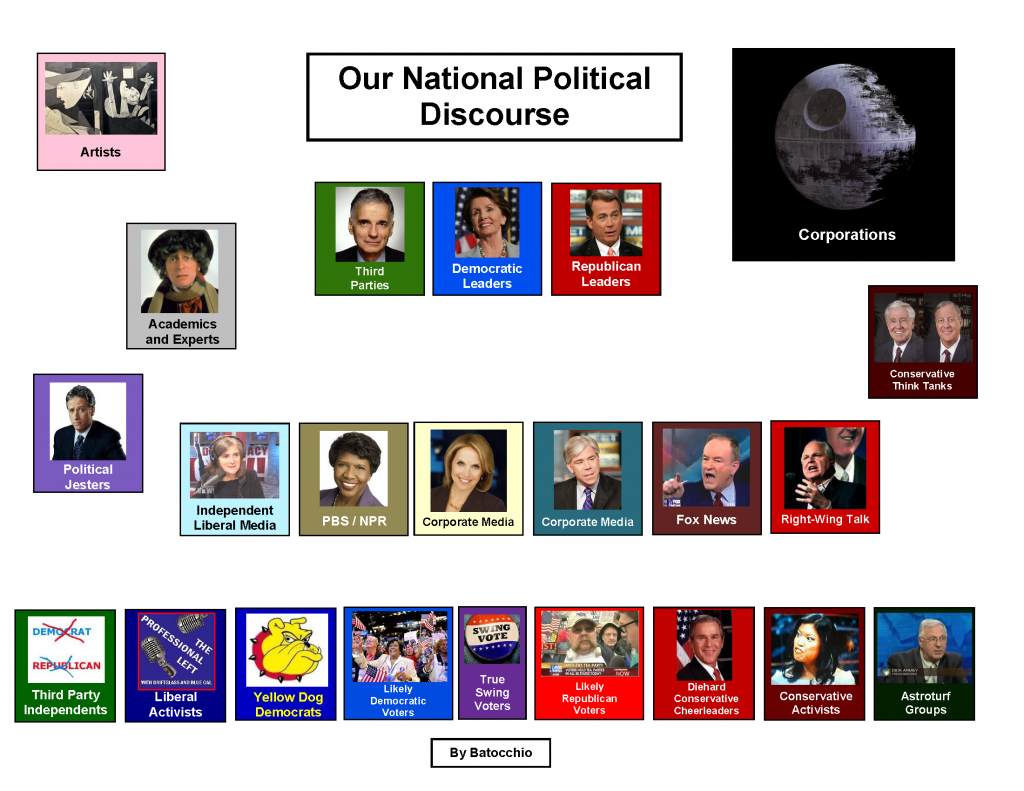
Here's a more complex graphic that better depicts the many disparate groups in our national political discourse:

(Click or go here for a better view. No lines for this one, because it would get too messy, but you can draw your own for specific groups. Yeah, I made this quite a while ago.)

This isn't drawn to scale, of course. For instance, third parties are smaller in terms of their actual influence, and corporations are much larger. (That's kinda a joke, but not really.) Corporations aren't always allied, either, but when it comes to politics, they tend to have one voice, which unfailingly promotes a pro-corporate viewpoint. (Several charts making the rounds show how corporate consolidation has increased over the years in the media and elsewhere.) In case there's any confusion, I'll briefly explain these different groups:

Democratic Leaders: The chart doesn't show smaller factions, such as the Congressional Progressive Caucus, but that one doesn't get a great deal of press, anyway. This icon represents the political leadership of the Democratic Party.

Republican Leaders: Likewise, smaller factions aren't shown (especially since members of "the Tea Party" are just rebranded conservatives). This icon represents the political leadership of the Republican Party.

Third Parties: More than one "third party" exists, and they don't agree on every issue, but obviously they all dislike America's two-party system. I picked Nader for this one because he's relatively well-known as a third-party candidate, but picture another figure (Jill Stein, Gary Johnson) if you prefer or find Nader too polarizing.

Corporations: It would be difficult to overestimate how much influence corporations exert on the entire political process, including the national political discourse. The "mainstream media" is for the most part corporate media, and it's rare that it will allow a viewpoint that isn't corporate-friendly.

Conservative Think Tanks: The pictured Koch brothers fund an enormous amount of conservative "thought" and media (sometimes called "the Kochtopus"). Their numerous outlets can give a false sense of multiple factions that are in consensus that the rich are taxed too much and so on, when in fact it's one message delivered by multiple mouths. Left-leaning and "centrist" think tanks do exist, but as SourceWatch notes, "there are twice as many conservative think tanks as liberal ones, and the conservative ones generally have more money." Exceptions exist, but for the most part, conservative think tank "scholars" are pedigreed hacks masquerading as wonks. Most nominally libertarian organizations can be placed here or with the conservative voting groups, the Libertarian Party notwithstanding. Although the Cato Institute and Reason, both Koch-funded, will stray off the conservative reservation on some issues (e.g. legalizing pot), they reliably support plutocracy or plutocrat-friendly policies, environmental deregulation, and a gutting of the Commons, just like the Kochs.

Academics and Experts: This group would be much better to feature in the news than most think tank "scholars," in that they're less likely to have a predetermined political agenda and more likely to tell the truth. However, some academics and experts aren't very good at explaining their field to laypeople, and some aren't good at facing off with hacks (who aren't there for an honest discussion).

Corporate Media: There's more than one corporate media outlet, and they're not always in complete agreement (hence the two icons, although many more could be added to represent the "mainstream media"). Still, they tend to share a basic worldview, often unconsciously, that defers to power, from corporate interests to elite Beltway consensus (the "Very Serious People").

Fox News: Although Fox News is also a corporate media outlet, it's significantly different in that propaganda is a key driver in addition to profit, and the network has shown eagerness in not letting the truth get in the way of a conservative political attack. (For more on this, see basically everything every posted at Media Matters.)

Right-Wing Talk: The hosts and guests on right-wing talk radio overlap considerably with those on Fox News, but there's enough separation it deserves its own category. (The radio-only crowd tends to be even crazier.)

PBS/NPR: Public broadcasting has its faults, but its news coverage is generally better than that of for-profit corporate outlets. It has a little more independence. (Its non-political stories are generally excellent; for anything touching on politics, they sometimes tread too carefully or even bend over backwards not to call out conservatives – unfortunately, conservatives frequently threaten to defund them.)

Independent Liberal Media: Truly liberal media outlets don't have the deep pockets behind them that other outlets do. Still, they do exist, even if they can be harder to find.

True Swing Voters: The notion of the "independent" voter is largely a myth, but there is a small group that will actually switch between the two major parties (or go third party) in major elections. (This mainly applies to national elections, not local ones.)

Likely Republican Voters: This group has a preference for the Republican Party and normally votes for it (at least on the national level). In certain circumstances, members of this group might vote otherwise.

Likely Democratic Voters: This group has a preference for the Democratic Party and normally votes for it (at least on the national level). In certain circumstances, members of this group might vote otherwise.

Diehard Conservative Cheerleaders: This group puts political party and the movement before most other considerations. General loyalty makes some long-term sense, but a "my party, right or wrong" attitude is a big problem, especially when a party/movement's leaders act egregiously. This is the group that still approved of George W. Bush as president no matter what, or stuck by Nixon to the bitter end (or, even if they never badmouthed him publicly, 'only liked him after Watergate').

Yellow Dog Democrats: This group puts political party before most other considerations. (As the joke goes, if the party nominated a yellow dog for office, these people would vote for it.) General loyalty makes some long-term sense, but a "my party, right or wrong" attitude is a big problem, especially when a party/movement's leaders act egregiously. Perhaps it's lack of opportunity, but I don't think this group has been as bad as their conservative counterparts. The closest equivalent would party loyalists who have defended actual (versus alleged) corruption by Democratic politicians or will not hear any criticism of the Clintons or Obama.

Conservative Activists: This group is typified by right-wing bloggers and activists (for instance, pro-life/anti-choice demonstrators). They believe they are the true conservatives and the rightful adjudicators of ideological purity. They tend to be more conservative than the politicians they eventually support (they almost all voted for Romney, but often supported other candidates in the primaries). Still, the activist-politician gap is smaller for them than for their liberal counterparts, since a sizable number of genuinely right-wing public officials do exist.

Liberal Activists: Members of this group tend to identify themselves as "liberals" or "progressives" rather than (or at least before) "Democrats." They typically think that the Democratic Party isn't liberal enough, and will criticize its politicians (although they may still judge them better than the Republicans on given issues or overall). For example, they probably agree with most positions of the Congressional Progressive Caucus or other individual politicians on the liberal end (e.g. Bernie Sanders), but are more critical of Democratic leaders and "centrist" to conservative factions such as the Democratic Leadership Council or Third Way. (It is true that the American Democratic Party as a whole is not very liberal compared to its international counterparts.)

Astroturf Groups: These groups pretend to be grassroots activists, but are actually heavily corporate-funded. Pictured is Dick Armey, former House Majority Leader and rich lobbyist, who went on to be the chairman of FreedomWorks (he's since resigned), a supposed "Tea Party" group backed by rich conservative donors. (And sure, Dick Armey, establishment millionaire, clearly spoke for the little guy as he claimed.)

Third Party Independents: This group is frustrated with the existing two-party system but also eschews internal reform in favor of supporting a third party instead. (There's more than one "third party," making the term technically inaccurate, but it's a common shorthand.) I wouldn't put establishment "centrist" groups such as "No Labels" in this category – they're closer to Astroturf Groups or perhaps the "Likely" groups.

Artists: Not every artist is politically insightful, but some are extremely astute. As we've discussed here before, the Arts can sometimes capture the true nature of politics (particularly its mindsets and pathologies) better than "straight" journalism can.

Political Jesters: The fools who can (and often do) speak truth to power. Sure, there are comics that traffic in cheap, shallow political humor, but The Daily Show and The Colbert Report, while not infallible, often do a better job at covering politics than traditional journalism, because they're not afraid to call bullshit. (In fact, it gives them greater credibility.)

Not pictured are the various political groups out there, because simply too many exist. Plus, many roughly align with the various voting/activist groups. For example, the right-wing group Focus on the Family fits in with the Conservative Activists, even though not all conservative activists are theocrats or even social conservatives. Meanwhile, the ACLU is nonpartisan, but right-wingers hate it and civil liberties so much (except when it comes to their own) that it gets pegged as "liberal." The same basic dynamics hold true for Planned Parenthood, if more contentiously because abortion (and unfortunately, even birth control) remain so politicized. Planned Parenthood follows both the law and standard medical practices, so it could be argued it's more "conservative" than the strident activists of Focus on the Family, but of course most conservatives would never see it that way, and such a stance does not describe actual conservatism (versus the fantasy version). As we've explored before, despite their hype, most self-described conservatives aren't fighting to maintain the status quo; they're fighting for what they view as the natural order with themselves on top. They often speak of these efforts as a "restoration," even though their preferred hierarchy is long gone (and was horrible, and remains widely rejected) or never existed in the first place.

It bears mentioning that not all reasons for being in a given group or listening to specific outlets are created equal. Nor is someone's self-labeling necessarily accurate. Voters often like to describe themselves as "independent" when they really mean "sensible." (Late in an election cycle, it's extremely rare for any "undecided" voters to be well-informed but truly ambivalent; at a certain point, almost everyone claiming to be "undecided" is a liar, attention-seeker, or ignoramus.) This chart could likely be improved, but I hope it's somewhat useful for discussing the mechanisms of political discourse (and how those affect the quality of discussion).

The Types of Guests (and Where the Process Breaks Down)

When it comes to political shows in the corporate media, the quality of the guests is often lacking. The various reasons for booking a guest are not all mutually exclusive, but the breakdown goes something like this:

Merit/Expertise: Guests possessing actual merit, expertise and insight on the subject matter should be the most valuable and the most common, but sadly, they don't dominate the airwaves. As mentioned above, academics and experts don't always know how to adapt their speaking style to the demands of a political show, and some wonks can be flustered by hacks. Additionally, the producer of the show booking guests has to have some sort of mechanism in place for evaluating actual merit. Ideally, someone on the producing team would have some small expertise to help judge potential guests or be able to obtain a recommendation from a trustworthy source. Some sharp potential guests may not be on the producers' radar (certain bloggers).

Reputation/Credentials: Instead of actual expertise, producers will often book guests based on reputation, which isn't quite the same thing, but the two aren't mutually exclusive. Paul Krugman, for example, certainly has the credentials to speak on economic matters, but he's also legitimately smart and insightful. Sadly, this category is where think tank hacks dubbed "scholars" often come in (as covered above, think tank wonks do exist, but certain institutions are dominated by hacks). This category is also the measure by which genuinely perceptive writers without a Beltway pedigree and worldview, such as Digby, are excluded.

Power: It's reasonable to book guests possessing the power to influence or outright control a vote or policy, even if their views have little to no merit. For instance, James Inhofe's notion that "global warming is a hoax" is batshit crazy, but he was the chairman of the Senate Committee on Environment and Public Works and fights for climate change denial wherever he can in Congress. The same dynamics held true when the Republicans held the debt ceiling hostage or have engaged in similar recklessness. Ideally, journalists will question those with power about the merit of their positions, but in the more corporate outlets, such pressure typically only goes so far.

Cosmetic Balance/Appeasement (Whining): This category demands the most discussion. Guests are booked because they represent a different point of view, even if that viewpoint has little to no merit. This makes more sense on the basic "power" level, inviting a representative of each major political party to discuss a policy or upcoming vote. It's much less defensible when there's a sizable "reality gap," and, say, an actual climate scientist is asked to debate an oil company shill, or a biologist is asked to debate a creationist on evolution, or any situation where an honest wonk is asked to debate a dissembling hack or sincere loon. This approach provides the image of balance while ignoring content and merit. Effectively, it entails that policy doesn't matter, because the show's producers essentially abdicate any fact-checking or vetting of merit, leaving this up to the viewer in the name of being fair while habitually denying the viewer crucial context for making an informed judgment. This approach is also employed to appease the conservative Wurlitzer, flogging its latest manufactured shitstorm, not that such appeasement typically works. (Liberals don't really have anything comparable.)

The late Molly Ivins, back in 1987, had a great take on these dynamics (emphasis mine):

The American press has always had a tendency to assume the truth must lie exactly halfway between any two opposing points of view. Thus, if the press present the man who says Hitler is an ogre and the man who says Hitler is a prince, it believes it has done the full measure of its duty.

This tendency has been aggravated in recent years by a noticeable trend to substitute people who speak from a right-wing ideological perspective for those who know something about a given subject.Thus we see, night after night, on MacNeil/Lehrer or Nightline, people who don't know jack-shit about Iran or Nicaragua or arms control, but who are ready to tear up the peapatrch in defense of the proposition that Ronald Reagan is a Great Leader beset by com-symps. They have nothing to off in the way of facts or insight; they are presented as a way of keeping the networks from being charged with bias by people who are themselves replete with bias and resistant to fact. The justification for putting them on the air is that "they represent a point of view."

The odd thing about these television discussions designed to "get all sides of the issue" is that they do not feature a spectrum of people with different views on reality:

Rather, they frequently give us a face-off between those who see reality and those who have missed it entirely. In the name of objectivity, we are getting fantasyland.

In "The Heritage Foundation Has Always Been Full of Hacks," Jason Stahl presents similar dynamics as the result of aggressive conservative lobbying in the 70s and 80s:

...The highest value in debating policy would no longer be “best solutions” but merely having a balanced marketplace where the ideas of liberals and conservatives would be heard simply because they “balanced” one another. Such a way of debating policy, which we are still living under today, means that a policy’s identity as a conservative one that balances a liberal one is the only thing required for it to be heard. Such a discourse does not rule out the idea that liberal and/or conservative policies could be founded on analytical rigor, but also does not require it.

This approach creates an anti-empirical, anti-qualitative, anti-content, anti-thoughtful, anti-social-contract, anti-policy framework for discussion. It's not good for the country, but it is a much cheaper product to churn out, especially in the bulk required for the 24-hour news cycle. It also provides the veneer of objectivity while generally discouraging deeper analysis. Good journalists still exist, of course, but their bosses higher up the ladder are another matter. Corporate media heads view news primarily as a commodity to be sold versus as a public service.

Member of the Club: This category often overlaps with Cosmetic Balance and Reputation, but when it's present, it's the dominating factor. Certain pundits and gasbags rarely say anything original and insightful, and at best shill the conventional Beltway wisdom (usually wrong) or their party's talking points. No matter how insipid or appalling their remarks, they never seem to be banned from the club; at best, they're banned for a short time. Reliable hack, grifter and verbal bomb-thrower Newt Gingrich is the poster child for this category, and proof the chattering class doesn't actually care much about "civility." (See driftglass on the Gingrich rules for much more.)

Headline Generation: This category can overlap with the others, especially Member of the Club, but doesn't necessarily. For example, in her heyday, Ann Coulter wasn't really a "member of the club" by Beltway standards, although she was a regular on Fox News and other right-wing outlets. Still, she was booked by major corporate outlets because she was ridiculous, inflammatory and "controversial." She didn't further the national discourse one iota, but she did generate headlines, and that made money. Newt Gingrich, who is a "member of the club," can be similarly counted on to say outrageous things in a calm tone to generate headlines.

The general public and corporate media heads often aren't seeking the same things in news coverage, and it would be wise to remember that.

A More Complex Outlook

In general, our national political discourse is shallow and discourages nuance. It also avoids assigning accountability if only one party is indicted. None of the following statements are unusual or difficult for reasonably intelligent, reasonably well-informed adults, but they're rare to find on the Sunday shows (especially the conclusions):

I could be wrong.
Wonks on my side could be wrong.
Wonks on the other side have some decent ideas.
The wonks on the other side are wrong on certain issues, but they're still decent people.
Dialogue with smart people who give a damn is a good way of coming up with better solutions.
Nevertheless, one side's ideas are qualitatively better.

Or:

There are hacks and scumbags in the political party I prefer.
Corruption is not limited to one party.
Nevertheless, one side is considerably less corrupt (at least on certain key issues).

Or:

There are ill-informed citizens who believe things that simply aren't true.
There are crazy people with genuinely dangerous ideas.
There are zealots with genuinely reckless ideologies.
There are people who seek power, whatever the cost to the country.
There are truly evil people in politics.
Many stupid, evil or crazy people don't view themselves as such.
Many dangerous, reckless or evil people are legitimized by the Beltway establishment or the corporate media.

Sadly, an American citizen will often be better informed if he or she avoids watching political talk shows, with their conventional, false wisdom and addiction to saying "both sides do it" and its variants. To quote a previous post:

…saying "both sides do it" is a form of trolling. In almost every case, when a Very Serious Person says "both sides do it," "both sides are to blame" or any of its variants, it is to shut down discussion, not to bring it to a deeper, more nuanced level.

Among honest, sane, reasonably intelligent and well-informed adults, the following are taken as givens:

1. Neither major party is entirely pure or entirely corrupt. You can find despicable and honorable people in both parties.

2. There is an inherent level of bullshit in politics. All politicians lie to some degree.

Naturally, the same crowd also holds that:

3. Nevertheless – actually, because of this – it's very important to take a closer look at politicians, parties, and their policies, and try to make an informed, comparative, qualitative judgment. Responsible citizenship and basic voting depends on it. Policy matters.

Strangely, most Beltway political commentators will endorse #1 and #2, but reject #3. The same media figures who sagely inform the public that politicians lie, as if this a revelation... will also refuse to fact-check their political guests. Instead of #3, they tend to hold the following views:

A. Wisdom lies precisely between the parties. One side cannot be significantly better/more correct than the other. It's impossible that one side can be overwhelmingly better!

B. It is rude to call out liars, or not invite them back after they lie.

C. Giving both parties a fair hearing necessitates judging that both arguments have equal merit.

D. Anyone saying harsh things about conservatives/Republicans clearly is closed-minded, hyper-partisan and not a Serious Person, regardless of the evidence.

All of this also entails:

E. Policy doesn't matter.

This mindset, whatever you want to call it – faux centrism, "sensible" centrism, centrist fetishism, establishment groupthink, bourgeois authoritarianism, the world view of Very Serious People, the Emperor's New Clothes, the ol' ruling class circle jerk – is absolutely fucking imbecilic. The people who shill it are often highly educated and have sterling pedigrees by Beltway standards, but they are shockingly shallow.

There's a saying that democracy is a form of government where the country gets what the majority deserves. That would be more accurate if our national political discourse were more honest, more accurate, more civic-minded and more in-depth.

(Previous posts on these themes: "Partisanship, Policy and Bullshit," "Both Sides Do It: Partisanship Redux," "Civil Both-Sides Partisans," "Common Ground and Equal Blame," "False Equivalencies," "The Bullshit Matrix" and "The Social Contract.")