Your last-minute cheat sheet for voting in key Los Angeles elections

-
Click here to listen to this article - Share via
See more from the L.A. Times in Google Search. Set us as preferred
You live in Los Angeles County and you’ve been too busy to focus on the local races.
Now, you have to vote.
Here is a last-minute cheat sheet covering key races in Los Angeles and L.A. County. Consider this an entry point to understanding the issues. We include links to our more in-depth guides:

Los Angeles mayor
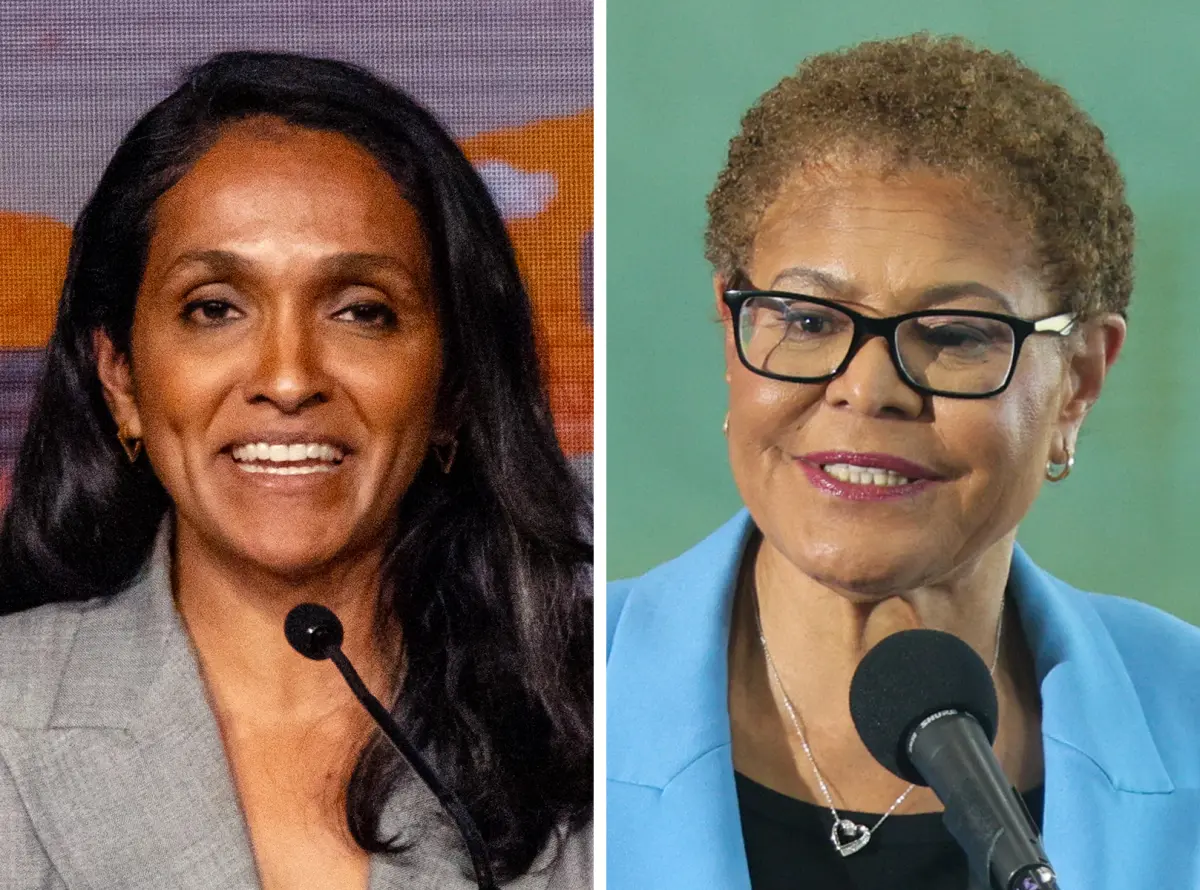
This race pits incumbent L.A. Mayor Karen Bass against Councilmember Nithya Raman.
The candidates
- Bass, 73, is a veteran lawmaker who served in Sacramento and Washington, D.C., before coming to City Hall. She’s drawn support from more traditional corners of the city’s political establishment, including Los Angeles County’s Democratic Party and its Federation of Labor, which represents hundreds of thousands of workers.
- Raman, 45, arrived in L.A. in 2013 and launched a City Council bid six years later. She’s been endorsed by the Democratic Socialists of America and other groups that are newer to city politics, including Streets for All, which seeks to expand the city’s bus and bike lane network.
In their own words
Here are Q&As with each of the candidates.

In an interview with The Times, Mayor Karen Bass talked about her response to the Palisades fire, police hiring, her management style at City Hall and her biggest mistake as mayor.

In an interview with The Times, Councilmember Nithya Raman addressed topics including homelessness, how her stance on the LAPD has changed over time, and her biggest mistake on the council.
State of the race
Bass has struggled with unfavorable ratings in the wake of the January 2025 firestorm. Homelessness, the Boyle Heights warehouse fire and other issues have made her vulnerable. But she holds a fundraising lead.
Raman says she’s a candidate of change. But some of her positions and her connection to the Democratic Socialists of America have raised eyebrows, and key allies are backing Bass.
The latest Los Angeles Times/UC Berkeley poll showed the race in a dead heat.
Issues
Housing
Bass points to fast-tracked affordable housing, while Raman has championed strong tenant protections. YIMBY groups back Raman; construction and trade groups favor Bass.

Karen Bass and Nithya Raman both have plans to help L.A.’s housing crisis. Will either make living here more affordable?
Policing
Bass has publicly backed Los Angeles Police Chief Jim McDonnell, saying the Police Department could be thrown into disarray if he is removed before the 2028 Olympic Games. Raman has called for a change in LAPD leadership without giving a clear timeline of when she would replace McDonnell if she defeats Bass.

Some observers see the November election between Mayor Karen Bass and challenger Nithya Raman as a referendum on LAPD Chief Jim McDonnell.

Mayor Karen Bass called on her opponent to apologize for her remarks about a former LAPD chief. Councilmember Nithya Raman said Bass deliberately twisted her words.
Environment
Bass has argued that Los Angeles remains a global leader on the environment, while Raman has said the city has lost its focus in recent years.

In a forum at L.A. Trade-Tech, the two mayoral candidates differed sharply over the city’s environmental performance under Bass’s leadership

The leading candidates have barely discussed how they would tackle the climate crisis. So we asked them.
Transportation
There are myriad public transportation challenges for the city’s next mayor, including the long-delayed LAX people mover, new rail lines and numerous traffic challenges related to the Olympics.

The delayed automated people mover at LAX, lags in street improvements and road safety initiatives are some of the challenges that mayoral incumbent Karen Bass or challenger Nithya Raman will face next year.
Olympics
The winner will be in office when the Summer Games come to Los Angeles in 2028. There remain concerns about whether the city could be left holding the bill. Raman initially opposed hosting the Games, and now says she will ensure they don’t cause financial problems. Bass says she is focused on the Olympics as a source of lasting benefits for the city.

Mayor Karen Bass is a big booster of the ’28 Summer Olympics in L.A.; challenger Nithya Raman? Not so much.
Homelessness
Bass made tackling homelessness a central effort in her first term. Despite some progress, the number of those who are homeless went up this year. Raman says she can do better but has faced criticism from some inside her district over how the issue has been handled.

Critics say the candidate failed to lead a homelessness committee with the urgency needed to combat L.A.’s enduring crisis. Raman claims that politics were at play.

Street homelessness — people living outdoors or in their vehicles — went down by 49% in Raman’s district compared to the previous year, she said at a press conference Friday.

L.A. mayoral candidates Bass and Raman skirmish over their support for small businesses. The San Fernando Valley is a battleground

The numbers from this year’s point-in-time homelessness count delivered a major blow to Bass, who is seeking reelection and has made the issue a central part of her agenda.

Los Angeles city attorney
The race for L.A. city attorney delivered a shock this spring when incumbent Hydee Feldstein Soto was ousted, an upset the likes of which hadn’t happened in nearly a century. The pair of candidates who remain have since laid out their widely differing visions of the job.
Here’s what you need to know.
The candidates
- John McKinney is an L.A. County deputy district attorney with nearly 30 years of legal experience. He vows to clean up what he calls a blighted downtown and work closely with his boss and backer, Dist. Atty. Nathan Hochman, to reduce crime in the city.
- Marissa Roy is a deputy attorney general in the California Department of Justice. She plans to use the office to fight for tenant and wage workers. Her campaign says the city attorney should be the “people’s lawyer” for L.A.

After a primary battle that ousted the incumbent, L.A. County prosecutor John McKinney squares off against Marissa Roy, a deputy attorney general with the California Department of Justice, in the race to become city attorney, a position that defends L.A. from lawsuits and prosecutes misdemeanors.
In their own words
Here are Q&As with each of the candidates.

L.A. County prosecutor John McKinney burst into the city attorney’s race earlier this year, becoming part of a historic primary upset of incumbent Hydee Feldstein Soto. If he wins this November, he’ll complete a lifelong underdog story that began with a tough upbringing in New Jersey.

Critics say candidate Marissa Roy, 34, lacks the ‘gravitas’ to be L.A. city attorney. Supporters see a chance to turn the role into a progressive champion of Angelenos.
State of the race
Roy is leading in the race to become the next Los Angeles city attorney. She was ahead by 10 percentage points in the most recent poll conducted by UC Berkeley’s Institute of Governmental Studies and co-sponsored by The Times.
Still, some local voters don’t know the candidates by name.

A new poll found that California Deputy Atty. Gen. Marissa Roy has a 10-point lead over her opponent, Deputy Dist. Atty. John McKinney, in the race for L.A. city attorney, but more than two-thirds of likely voters remain undecided.
Issues
Criminal justice
- McKinney is focusing his campaign on tamping down quality-of-life crimes in the city such as organized retail theft, drug dealing and street racing. McKinney would prioritize public safety and vows to go after demonstrators who block freeways or engage in conduct similar to the 2024 pro-Palestine encampments on UCLA’s campus.
- Roy wants to funnel nonviolent offenders to diversion programs such as mental health treatment or vocational training.
Hefty legal payouts
- McKinney said he’d lean on his long experience as a trial attorney to quickly decide which incoming lawsuits against the city should be fought and which should be settled in order to reduce the city’s legal costs.
- Roy wants to bring civil litigation back in-house to rein in the millions spent on outside counsel. She also argues for beefing up the claims process so legitimate suits are settled effectively and frivolous ones are fought.
How each candidate would handle Trump
- McKinney would work to balance respecting federal authority as required by law against protecting the constitutional rights of city residents and defending local resources if threatened by federal overreach.
- Roy has made fighting the Trump administration a centerpiece in her campaign.
Homelessness
- McKinney wants to use the court system as a “last resort” to leverage people into accepting services or shelter.
- Roy says renter protections will be vital to stemming the city’s homelessness crisis.

Los Angeles County sheriff
This is a rematch between rivals for the job of running the Sheriff’s Department, which also oversees county jails.
The candidates
- Robert Luna is the sitting sheriff. The former Long Beach police chief, Luna came out of retirement to run for sheriff in 2022, arguing that incumbent Alex Villanueva had taken the department in the wrong direction. The department says the number of new deputies graduating from the sheriff’s academy has risen. Luna points out that violent crime has fallen every year since he took office. Between 2023, his first full year in office, and 2025, homicides fell by more than 25%.
- Alex Villanueva was elected sheriff in 2018 in an upset victory. His tenure was marked by controversy, and he became a favorite of conservative media. He faults Luna, saying the department has issues with recruitment and retention. County and Sheriff’s Department records confirm that, although sworn vacancies more than doubled during Villanueva’s term from about 477 in December 2018 to 1,069 by Nov. 9, 2022, Luna has presided over a further increase in sworn vacancies to 1,452 three years later. Villanueva also says the department does not have the resources it needs.

Robert Luna unseated Alex Villanueva as Los Angeles County sheriff in 2022. Now Villanueva is seeking to reclaim his position at the helm of the Sheriff’s Department.

Los Angeles Community College District trustees
The Los Angeles Community College District is the largest community college district in the nation, serving 200,000 students with a budget of $10 billion.
Voters will elect three members to the board.
Seat 2
Steven F. Veres
Veres is a member of the Los Angeles Community College District Board of Trustees and works as a state political adviser. He says he has worked to strengthen job training programs and improve graduation rates and wants to make college as affordable as possible.
Robert Payne
Payne taught at L.A. Mission College, worked on movie crews and ran an import business. He would focus on low enrollment growth. He also wants to make community colleges “cheaper, faster, better” in part by offering students more training for specific jobs and less expensive online textbooks.
Kristina Irwin
Irwin serves on the general advisory board at Santa Monica College. She previously served on the board of trustees at Palisades Charter High School. She wants to offer students more tools to succeed in college and to establish “preentry” programs in every local high school to better prepare students for community college.
Adriana Cabrera
Cabrera served as president of the Central Alameda Neighborhood Council and co-founded Empowering Youth in South Central. She wants to make student services easier to navigate and to strengthen financial aid and other support, including for food, housing, child care and mental health.
Roy Payan
Payan has suspended his campaign.

Five candidates are vying for Seat 2 on the board of trustees for the Los Angeles Community College District, where they will oversee some 200,000 students and an annual budget around $10 billion. Here is your voter guide.
Seat 4
Nancy Pearlman
Pearlman is an environmentalist who served on the LACCD Board of Trustees from 2001 to 2017 and taught part time at all nine colleges. She would focus on improving low enrollment while ensuring students are given the necessary support and resources to succeed. She also cites the need to make sure faculty receive equal pay.
Darryn Harris
Harris is a government and community affairs officer for St. John’s Community Health and teaches at Santa Monica College. Harris wants to tackle the affordability crisis blocking student achievement by building more low-cost housing on district land and making it “easier for students to get help with food, transportation, child care, and other basic needs.”
Adam Bruno
Bruno has worked as a therapist helping children and been a community college student. His main goals are to increase enrollment and make it easier for students to afford college. He’d explore student stipends as a way to make community college more affordable.
Elaine Alaniz
Alaniz serves as a public affairs specialist with the U.S. Small Business Administration’s Office of Disaster Recovery and Resilience. She wants to better prepare students for a changing workforce and ensure classroom instruction “keeps pace with a rapidly changing workforce” in the age of artificial intelligence and other technologies.
Isidro J. Armenta
Armenta did not reply to The Times’ survey.
Priscilla Umana
Umana works as an American Sign Language interpreter. She says the district’s biggest challenge “is the high percentage of students experiencing housing insecurity, homelessness, and food insecurity.” She would work with the district to expand affordable housing, work-study opportunities and food aid.
Jason R. Aula
Aula has worked as a political campaign consultant and in the world of mobile apps. He considers fraud a major issue including people posing as community college students to steal financial aid. He proposed a moratorium on noncitizens attending district schools and a focus on pandemic learning loss.

Seven candidates are vying for Seat 4 on the board of trustees for the Los Angeles Community College District, where they will oversee some 200,000 students and an annual budget around $10 billion. Here is your voter guide.
Seat 6
Gabriel Buelna
Buelna serves on the board of trustees. He also is an attorney and teaches history and political science at Cal State Northridge. He said a key issue is making college more affordable to students and ensuring that they graduate. He also said the board must conduct strong fiscal oversight of the billions in voter-approved bond funds.
Tonia Arey
Arey has worked in real estate, public advocacy and community engagement. Arey would work to implement campus safety plans, support additional academic advising and career education and more closely “examine spending, contracts, program outcomes and administrative costs to ensure resources reach classrooms and directly support students.”
Randall Winston
Winston works as a licensed architect and attorney and serves as Los Angeles’ deputy mayor of infrastructure and climate resilience under Mayor Karen Bass. Winston’s priorities for the district include ensuring colleges are a pathway to opportunity and good jobs, that students can afford basic needs and that people historically shut out of higher education are let in.

Four candidates are vying for Seat 6 on the board of trustees for the Los Angeles Community College District, where they will oversee some 200,000 students and an annual budget around $10 billion. Here is your voter guide.

Los Angeles Superior Court judges
Voters decide four runoff contests for Superior Court seats on Tuesday, choosing who will preside over criminal and civil cases across the region.
Seat 131
The candidates
- Donna Tryfman, a deputy public defender, serves in the major cases unit, where she handles homicide and other high-profile defendants. She also has extensive experience in juvenile cases.
- David Ross is an alternate in the Torrance branch of the public defender’s office and also works in Bellflower and Long Beach. He claims to have represented more than 10,000 clients at hearings and in trials.
The Los Angeles County Bar Assn. rates both attorneys as “qualified” for office. Ross said his mix of legal and life experience and his time as a journalist, when he “listened to real people, gathered the facts and told objective stories,” provide a unique perspective. Tryfman has served as a Superior Court judge pro tem, handling traffic and small claims cases. She has proctored teen courts at Dorsey and Hamilton high schools.

Donna Tryfman and David Ross are competing for the Superior Court Judge Office 131 seat. Here’s what you need to know about the race.
Seat 64
The candidates
- Maria Ghobadi is an L.A. County deputy district attorney. As a child, Ghobadi fled Iran with her family during the Islamic Revolution and settled in Southern California. She joined the L.A. County District Attorney’s Office in 2015 and has handled misdemeanors, felonies and domestic violence cases. She’s spent seven years in the gang homicide division.
- Rhonda Haymon is an L.A. County deputy public defender. She grew up in Southern California and became an attorney in 2001. She started in the Orange County public defender’s office before moving to L.A. County, where she’s spent 23 years as a deputy public defender. She has been assigned to a restorative justice drug court and consulted on police misconduct cases.
The Los Angeles County Bar Assn. ranked Ghobadi as “well qualified” and Haymon as “qualified.”

Maria Ghobadi and Rhonda Haymon are competing for the Superior Court Judge Office 64 seat. Here’s what you need to know about the race.
Seat 87
The candidates
- David DeJute, who defended President Obama against the so-called birther claims, spent a decade as vice president of litigation at Sony Pictures Entertainment. He now works in litigation at a private firm. An adjunct professor at Pepperdine’s Caruso School of Law, he’s taught ethics, antitrust, copyright and patent law. After last year’s wildfires, he returned as director of the disaster relief clinic, where he instructed students who provided pro bono legal services to victims of the Palisades and Eaton fires.
- Anthony “A.J.” Bayne’s background includes nearly two decades serving in the Compton Courthouse, where for a time he served as deputy in charge. He’s now handling serious felony cases at the Torrance branch. Bayne is an inventor, with patent-pending applications for artificial intelligence tools that automate legal workflows. One helps with closing arguments; another uses court reporter transcripts to generate cross-examination questions.
DeJute is rated “qualified” to serve by the Los Angeles County Bar Assn. Bayne is rated a notch higher, “well qualified.”

Anthony “A.J.” Bayne and David DeJute are competing for the Superior Court Judge Office 87 seat. Here’s what you need to know about the race.
Seat 65
The candidates
- Justin Allen Clayton is in charge of the Inglewood branch of the public defender’s office and has defended three cases with life sentences. Clayton said a priority is improving court efficiency through pretrial preparation and “firm but fair enforcement of deadlines.” Clayton said running a public defender branch office gives him a “comprehensive understanding” of the courtroom.
- Anna Slotky Reitano represented juvenile and adult clients, many of them accused of felonies, before joining the county counsel’s office. Reitano focused on mental health diversion and treatment, aiming to support rehabilitation when possible. A former child actor, she volunteers with local schools and, according to her website, mentors “future lawyers” through moot court competitions.
The Los Angeles County Bar Assn. considers both qualified to serve.

Justin Allen Clayton and Anna Slotky Reitano are competing for the Superior Court Judge Office 65 seat. Here’s what you need to know about the race.

L.A. County Charter Amendment A
This measure deals with labor negotiations for key public safety personnel in L.A. County.
Basics
Measure A is a charter amendment that would require binding arbitration between county government and negotiators representing sheriff’s deputies, firefighters, lifeguards and other public safety workers if contract talks reach an impasse and no compromise can be reached. It would alter the current last step, in which county supervisors can impose a final offer that these employees must accept — by law, public safety personnel cannot strike.
Impact
The initial phase of contract talks still would have union and county representatives seeking to hammer out a mutually beneficial deal, with a presumption that both sides would negotiate in good faith. But if a gap remains and an impasse ultimately is declared, the supervisors no longer would dictate the final offer. Instead, a three-member arbitration panel would be formed. The county and union each would select one member, with the sides together choosing the third person, who would serve as chair. If they can’t agree on the final panelist, a state entity could provide a list of qualified arbitrators to choose from. The arbitrators would focus on key employment elements such as wages and hours and would hold hearings and receive evidence from the parties. At the end of the process, a binding result would be issued and made public.

Measure A would require binding arbitration if talks between county officials and unions representing sheriff’s deputies, firefighters, lifeguards and other groups reach an impasse.

L.A. County Charter Amendment E
This is a complicated measure that involves jail financing and seeks to clean up some bureaucratic muddles.
Basics
Jails: In 2020, 57% of county voters approved Measure J. This mandated that at least 10% of locally generated, unrestricted revenue be allocated to incarceration alternatives. The problem? Voters later approved the county reform effort Measure G, which had the unintended effect of repealing Measure J. Measure E would ensure that Measure J remains in effect.
Governance: Measure G also created, among other things, a county ethics commission and an ethics compliance office. Officials determined that for true independence, the commission and the compliance office must be permanently enshrined in the county charter.
Impact
Backers say Measure E would clean up those messy governmental issues.

County voters are being asked to fill in gaps to implement previously approved ethics reforms and fix a goof that invalidated a jail alternatives proposal.


More From the Los Angeles Times


Podcasts

William Mulholland was the water boss who made L.A. possible. His reputation gave him unchecked authority as a dam builder. In 1928, that led to one of America’s deadliest disasters--and the question of whether it was a crime.

It started as a ploy to scare Texas out of redrawing its congressional map and ended with California voters approving a new map of their own, one that could hat could help alter the balance of power in Washington.

On this week’s episode of Boiling Point, Miranda Green speaks with Los Angeles Times climate reporter Hayley Smith about how AI bots are meddling in California’s clean energy policymaking.


