Showing posts with label Frank McCarthy. Show all posts

Tuesday, July 4, 2023

Peril Makes an Entrance


(Above) Murder Is the Pay-Off, by “Leslie Ford,” aka Zenith Jones Brown (Dell, 1954). Cover illustration by Carl Bobertz.


Last year, while preparing to write a piece for CrimeReads about “colorful [paperback] cover themes from crime fiction’s past,” I put together a dozen or so sets of vintage examples that I found interesting and upon which I could cleverly comment. I wound up narrowing those down to just seven, including book fronts featuring threatening vehicles, oversized heads, women’s legs, and disembodied hands. Among the discards were covers on which men of a suspicious character either hid behind or sought to break through doors in order to menace women on the other side.

I figured at the time that those might be useful later, in some way or other. But I hadn’t given any further thought to them until last month, when I happened across the 1953 Dell edition of George Harmon Coxe’s Venturous Lady and decided to blog about it as part of this page’s “book fixes” series. Artist Griffith Foxley painted the front of that 80-year-old paperback, which shows a woman hiding in a bedroom, as a man pushes open the door, gun in hand.

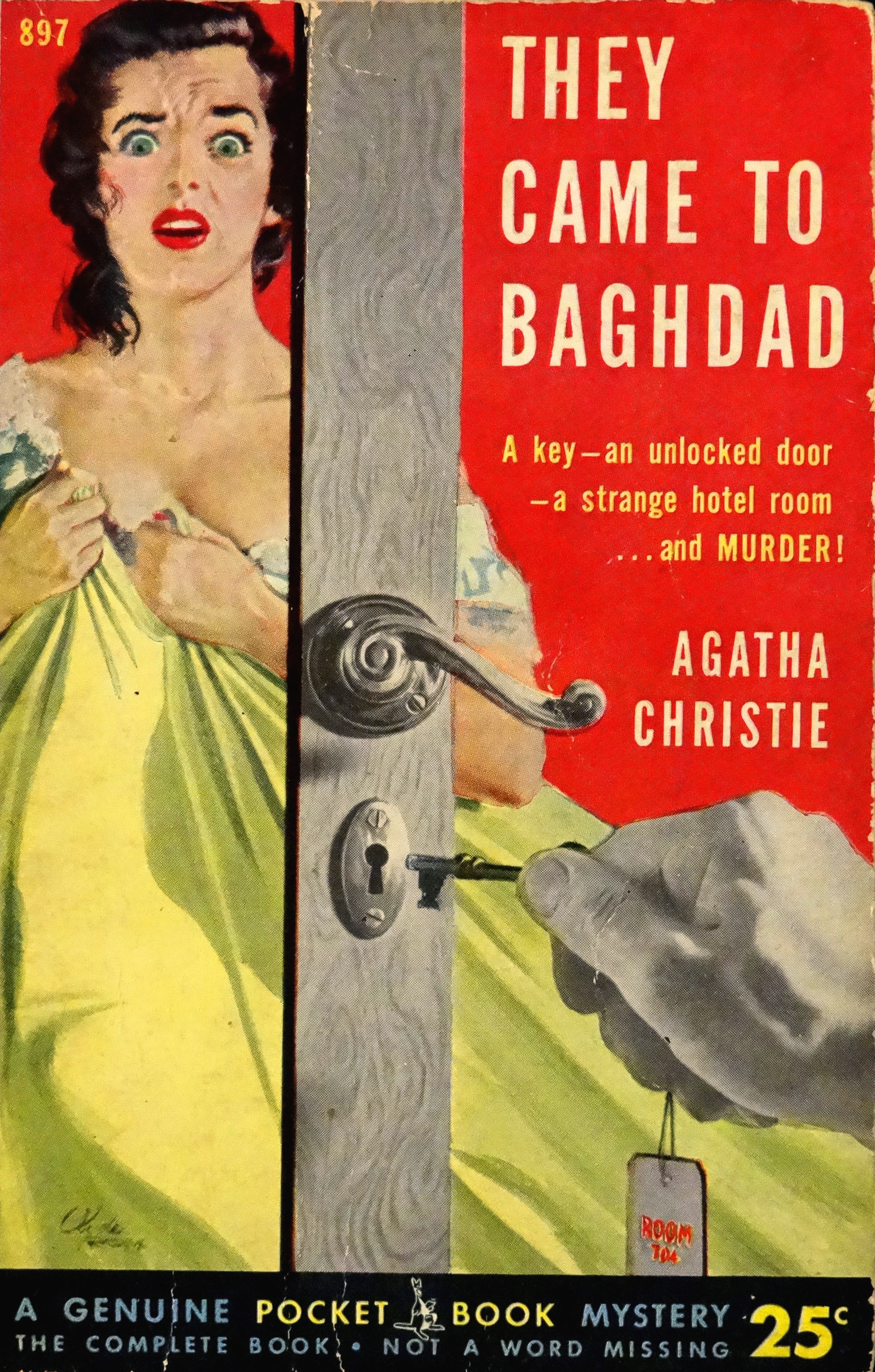
This seems like as good a time as any to dust off the remainder of the door-danger covers in my collection, and display them here. Among the illustrators whose work graces the following 14 paperback covers are Ed Grant (The Fabulous Clipjoint), Clyde Ross (They Came to Baghdad), Barye Phillips (Knock Three-One-Two), Mitchell Hooks (Stranger at the Door), Frank McCarthy (The House Without a Door), Lu Kimmel (Runaway Black, written by Ed McBain under the pseudonym Richard Marsten), Victor Kalin (Killer with a Key), and Robert Stanley (The Glass Triangle). I already wrote several years ago about The Crooked Man and There Was a Crooked Man, but added them to this gallery too, because they so well fit the theme.


Women confronted by dangerous gents at doors weren’t only seen on softcover novels of old. They served equally well on crime-fiction magazines, as evidenced by the July 1946 issue of Detective Tales and the March 1957 number of True Detective. Unfortunately, I do not know who painted either of those fronts.

Tuesday, November 19, 2019

Ending the Great Book Hunt


For those of you who have been keeping track of progress toward cleaning out my late in-laws’ residence (see previous posts here and here), I thought I’d better offer a final accounting. After a year’s consistent—and frequently frustrating—labors, and way too much dust ingested along the way by everyone participating in this endeavor, the job has finally been completed. And the house has been put on the market. It’s a small but fairly cute suburban abode, really, though the buyer will likely have to spend a good chunk of change replacing the antiquated wiring, fixing up spots where water leaks occurred over the years, and tearing out all of the damp and worn carpeting. (My in-laws apparently thought that ignoring the problems with their living conditions for a few decades would magically make them go away.)

(Right) Crime and mystery fiction scholar Howard Haycraft

In addition to just lifting and hauling overfilled boxes, many of them stuffed to the brim with garage-sale items that had been once acquired and then never used, my job throughout this project was to gather together the thousands of books we found inside the house and garage (mostly boxed and packed away, rather than on display), and divide those I thought might be worth selling from those that were best given away or—in the case of moldy works—thrown out with regret.

Because my wife’s birth father was a big reader of crime and mystery fiction, I was rewarded during this “excavation” with occasional discoveries of long-buried, primarily paperback copies of yarns by big-name writers such as Erle Stanley Gardner, John D. MacDonald, M.E.Chaber, and Ian Fleming. However, since my last post on this subject, I also managed to find among the clutter a two-volume, hardcover set called A Treasury of Great Mysteries, edited by Howard Haycraft and John Beecroft, and published in 1957 by Simon & Schuster. In addition to full novels by the likes of Agatha Christie (Murder on the Orient Express), Raymond Chandler (The Big Sleep), and Daphne du Maurier (Rebecca), it contains novellas by Ellery Queen and Rex Stout, and short stories penned by Georges Simenon, Patrick Quentin, Ngaio Marsh, and others. I already own many of these yarns in different editions; and the condition of the two volumes isn’t perfect (the covers will require plastic jackets in order to extend their life, and the pages smell a bit musty). However, A Treasury of Great Mysteries seems to be regarded as something of a landmark publication, and Haycraft (1905-1991) is celebrated as an early authority on this genre, his 1941 anthology, Murder for Pleasure, being much-prized. So I’ll add this pair of volumes to my personal library and, when I get a chance, read the stories in them that I have not already enjoyed. (You can see the full jackets here.)


Worth saving too, I think, are what appear to be a first-edition hardcover copy of Queen’s Cat of Many Tails (Little, Brown, 1949), though it’s missing its original jacket; a 1942 Sun Dial Press reprint of Charteris’ The Saint vs. Scotland Yard; a 1969 Bantam Books release of the James Bond novel Colonel Sun, by “Robert Markham” (aka Kingsley Amis), with cover art by Frank McCarthy; and Fannin, a retitled 1958 Unibook edition of David Markson’s Epitaph for a Tramp, with cover art attributed to Ron Lesser. (When contacted about this illustration, Lesser responded: “It looks like mine from that period; however the poses [and model] photography do not look familiar. I am not sure either way. Your guess is as good as mine.”)


Of course, not all of the books salvaged from my in-laws’ house fall into the categories of crime, mystery, or thriller. Rescued, too, was a 1973 Beagle romance paperback titled Pool of Dreams, by “Lucy Walker” (aka Dorothy Lucy Sanders), with a cover painting signed “W. Popp” (which I presume to mean Walter Popp); a 1967 Dell edition of Madeleine L'Engle’s adult standalone novel, The Love Letters (its illustration credited only to “Thomas”); 1973’s Making U-Hoo (Dell), a soft-core porn novel by Irving A. Greenfield; and a 1974 Fawcett Crest reprint of The Devil on Lammas Night, by British author Susan Howatch (with art by the great Harry Bennett).


Sadly, my wife’s mother and stepfather, along with her birth father, have now all passed away, so I can’t learn who purchased and read these various works. While I understand that her mother was a prodigious consumer of romances, and her father laid claim to most of the crime and westerns/historicals (we found lots of Louis L’Amour novels stored away and a full but rather mildewed set of Dana Fuller Ross’ Wagons West series), I remain curious as to who left behind the bawdier stories that kept turning up. In all likelihood, nobody who lived in that house would ever admit to having such tastes.

Monday, January 14, 2019

Another Look: “The Case of the Drowning Duck”

Warning: Artistic inspiration drawn from book titles may vary.


Left: The Case of the Drowning Duck, by Erle Stanley Gardner (Pocket, 1949); cover art by Louis Glanzman. Right: The Case of the Drowning Duck, by Erle Stanley Gardner (Pocket, 1950); cover illustration by Frank McCarthy.

Monday, November 19, 2018

Forsaken No More!


My wife’s stepfather died in September, about two years after her mother passed away. Over the last couple of months, members of the family have been prudently cleaning out the small but overstuffed house in which those two resided for so long, trying to make sure that the rest of us take whatever we want or can use, before the remainder is dispensed through an estate sale or hauled off to Goodwill. One of my jobs has been to cull and clean all of the books on the premises, many left packaged and stored in a cold, rat-infested garage ever since my wife’s parents divorced four decades ago.

I spent most of this last Saturday opening boxes, setting aside books I thought would be of interest to individual family members, and dividing the surplus majority into piles of works that (1) were in good shape and of potential interest to a local used bookshop, or (2) were less presentable or belonged to genres (romance novels, westerns, and politically incorrect joke books, etc.) that might attract buyers’ eyes only if severely marked down for immediate sale. I was surprised at how many books had survived, given the negligent conditions under which they’d been preserved.

From the thousands of books I went through—many of which had originally belonged to my wife’s father, a crime-fiction fan—I pulled out perhaps a dozen works of interest to me. For instance, I snagged a 1944 Pocket edition of Leslie Charteris’ Enter the Saint; one of Erle Stanley Gardner’s early Perry Mason novels, The Case of the Howling Dog (1934); and a hardcover edition of Joe David Brown’s Paper Moon (originally published in 1971 under the title Addie Pray). I also happened across a 1971 Bantam paperback edition of Ian Fleming’s first James Bond novel, Casino Royale—shown atop this post—featuring cover art by Frank McCarthy. (You can see the back of that book here.)

There were a few other gems, as well: 1970s Paperback Library editions of three Milo March mysteries by M.E. Chaber (aka Kendell Foster Crossen), with fronts illustrated by Robert McGinnis; Dell’s 1958 issue of The Big Country—originally titled Ambush at Blanco Canyon—by Donald Hamilton, creator of the Matt Helm series; and a couple of John D. MacDonald books that I didn’t already own, The Neon Jungle (Fawcett Gold Medal, 1953) and The End of the Night (Fawcett Gold Medal, 1960). Scans of those six are below.


Beyond all of those, I stumbled onto a pair of romantic suspense novels, both boasting cover art by the great Harry Bennett: The Moon-Spinners, by Mary Stewart (Fawcett Crest, 1968) and Snowfire, by Phyllis A. Whitney (Fawcett Crest, 1974).


There are still more boxes for me to go through at my in-laws’ home, so we’ll see what others treasures might present themselves.

Sunday, May 15, 2011

Long Live the Queens!


Much of my time lately has been devoted to working on a crime-fiction encyclopedia project, writing about the two Brooklyn-born cousins--Manfred B. Lee and Frederic Dannay--who penned dozens of 20th-century American mystery novels under their joint pseudonym, Ellery Queen. So it seems appropriate that my latest gallery of covers should concentrate on their published efforts.

Ellery Queen was once a famous name in crime-writing circles. Hundreds of editions of the cousins’ books (some of them carrying alternative titles) have been produced since the first novel carrying that byline, The Roman Hat Mystery, appeared in 1929. To catalogue every one of those book fronts would be a monumental, if not impossible task. Instead, I’d just like to share some of my favorites, with artwork provided by such masters as Arthur Sussman, Harry Bennett, Frank McCarthy, and Sam Peffer. Also James Meese, who supplied the mysterious and seductive illustration that decorated Cardinal Books’ 1960 paperback edition of The Greek Coffin Mystery (1932), shown at the top of this post.

Click on any of the images below for an enlargement.


Finally, here’s Dell Books’ 1946 “mapback” edition of The American Gun Mystery (1933), with front illustration by Gerald Gregg and a rear-cover map of the crime scene by Ruth Belew.


READ MORE: “The Rap Sheet: Calamity Town by Ellery Queen,”
by J. Kingston Pierce (Kirkus Reviews).