
• Having already written about artists Tom Adams and Mara McAfee, both of whom painted elegant covers for paperback editions of Agatha Christie’s novels, Passing Tramp blogger Curtis J. Evans today provides an assortment of other mid-1900s Christie fronts. Among them are works by William Teason (1922-2003).
• The Paperback Palette’s Jeff Christoffersen has a new post out this month about “consummate illustrator” Gordon Johnson (1924-1989), who created artwork for books by David Morrell, Helen MacInnes, Jack Higgins, Donald Hamilton, and many other authors. “Johnson’s forte was realism,” explains Christoffersen, “starting with the illustrations he produced for various magazines in the 1950s, such as The American Weekly. It would seem that his first book commissions, or those that I’ve been able to discover, adhere from about the mid-1960s, and constitute mostly teen titles from publishers like Grosset & Dunlap and Whitman. From that point on though, Johnson did what all ‘consummate’ illustrators did when the great Silver Age of Mass-Market Paperbacks got heralded in, he began producing cover art for nearly every major paperback house in New York City. Along the way he mastered each and every genre that stood before him, the ‘fantastics’ being perhaps his only overlook.”
• Finally, prolific author-blogger James Reasoner has more than a few nice things to say about George Gross: Covered (New Texture), the latest book-length study of a classic magazine and paperback artist by Robert Deis and Wyatt Doyle. “This is one of the most beautiful books you’ll ever see,’ he writes, “reproducing in vivid detail many of those MAM [men’s adventure magazine] covers Gross painted. I’d post some scans of those issues, but they wouldn’t come close to equaling the reproduction in this book. In addition, Deis and Doyle provide an informative introduction, David Saunders contributes a fine biographical essay about Gross and his work, and fellow artist Mort Kűntsler, who was mentored by Gross, reminisces about their friendship and offers expert comments about Gross’s work.” Although I’ve not yet ordered a copy of this book, it’s definitely on my must-have list. And based solely on its cover art, I shall plunk down for the paperback edition.
Showing posts with label George Gross. Show all posts
Showing posts with label George Gross. Show all posts
Wednesday, September 21, 2022


Tuesday, August 9, 2022
Casting a Wide Net for Links
• Raymond Johnson’s art featured regularly on mid-20th-century paperback covers, particularly those in the crime- and science-fiction categories. I’ve showcased Johnson’s paintings a number of times in Killer Covers, but have always been curious to know more about the artist himself. So I was excited to hear that Rubén “DaCollector” Azcona, a regular contributor to the private Today’s Inspiration Facebook Group page, would be conducting a YouTube interview with Lowell Wilson, author of a beautiful new feature in Illustration Magazine about Johnson. Their exchange can now be seen here in its 2.5-hour entirety. Wilson shares myriad examples of Johnson’s work, some of which graced more than one paperback front, and a few I didn’t know were done by Johnson. Promptly after watching this interview, I ordered a copy of the Illustration Magazine (#77) in which Wilson’s profile appears. How could I pass it up?
• I love it when the blog Pulp International delivers its irregular cover-theme posts. The latest one collects “vintage paperback covers featuring characters on both the giving and receiving ends of knives—or knifelike tools such as icepicks.”
• Speaking of art themes, Paperback Palette blogger Jeff Christoffersen looks back here at artist Rudy Nappi’s many Nancy Drew (ND) covers. As he explains, “In 1952, Rudy Nappi was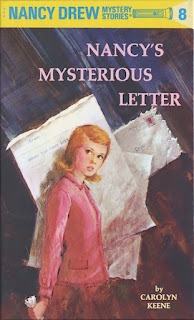 assigned by publisher Grosset & Dunlap to create cover art for their original Nancy Drew Mystery Stories. He concluded his stint in 1979 with what is considered to be the final volume in the original series, volume 56. … Nappi tried to honor the original existing cover art wherever he could, while also updating Nancy’s look as per his publisher’s instructions. Eventually, he followed his own instincts, and his wife’s, who actually read the books on his behalf, composing new scenes for some titles, and on others actual montages, a first for the series. Nappi painted most of these with gouache on board. Along a similar vein, and coinciding with the ND’s, Nappi produced more than 58 of the original Hardy Boys series covers for the same publisher.”
• For the blog Kevin’s Corner, author James R. Benn relates some of the history behind the covers featured on his World War II-era Billy Boyle books, including the 17th and latest installment, From the Shadows, due out next month from Soho Crime.
• Here’s another good reason to go on living! Robert Deis and Wyatt Doyle, who have already published handsomely illustrated volumes about artists Samson Pollen and Mort Künstler, are preparing to release a new book focused on Brooklyn-born painter George Gross (1909-2003). Gross, writes Deis, “was one of the greatest of the many great illustration artists who created cover and interior illustrations for the men’s adventure magazines … In the 1950s, 1960s and 1970s, Gross was also a top cover artist for paperbacks.” The authors debuted George Gross: Covered at the recent PulpFest in Pittsburgh, but haven’t yet made it available on Amazon, Book Depository, or other sales sites. Deis says he’ll post a preview of the work in his blog soon. Watch for it!
• Finally, Michael Stradford, the man behind Steve Holland: The World’s Greatest Illustration Art Model and Steve Holland: Cowboy, reminds us that not only did Holland serve as the model for “Doc Savage, The Spider, The Phantom, The Avenger, countless cowboys and other iconic fiction characters,” but he was also cast as “television’s first ‘Flash Gordon.’” Holland, of course, filled the boots of comic-strip artist Alex Raymond’s space adventurer in the DuMont Network’s 1954-1955 series Flash Gordon. If you’ve never seen any of that show’s 39 half-hour episodes, you’re in luck: Stradford has embedded a colorized example in his post here.
• I love it when the blog Pulp International delivers its irregular cover-theme posts. The latest one collects “vintage paperback covers featuring characters on both the giving and receiving ends of knives—or knifelike tools such as icepicks.”
• Speaking of art themes, Paperback Palette blogger Jeff Christoffersen looks back here at artist Rudy Nappi’s many Nancy Drew (ND) covers. As he explains, “In 1952, Rudy Nappi was
 assigned by publisher Grosset & Dunlap to create cover art for their original Nancy Drew Mystery Stories. He concluded his stint in 1979 with what is considered to be the final volume in the original series, volume 56. … Nappi tried to honor the original existing cover art wherever he could, while also updating Nancy’s look as per his publisher’s instructions. Eventually, he followed his own instincts, and his wife’s, who actually read the books on his behalf, composing new scenes for some titles, and on others actual montages, a first for the series. Nappi painted most of these with gouache on board. Along a similar vein, and coinciding with the ND’s, Nappi produced more than 58 of the original Hardy Boys series covers for the same publisher.”
• For the blog Kevin’s Corner, author James R. Benn relates some of the history behind the covers featured on his World War II-era Billy Boyle books, including the 17th and latest installment, From the Shadows, due out next month from Soho Crime.
• Here’s another good reason to go on living! Robert Deis and Wyatt Doyle, who have already published handsomely illustrated volumes about artists Samson Pollen and Mort Künstler, are preparing to release a new book focused on Brooklyn-born painter George Gross (1909-2003). Gross, writes Deis, “was one of the greatest of the many great illustration artists who created cover and interior illustrations for the men’s adventure magazines … In the 1950s, 1960s and 1970s, Gross was also a top cover artist for paperbacks.” The authors debuted George Gross: Covered at the recent PulpFest in Pittsburgh, but haven’t yet made it available on Amazon, Book Depository, or other sales sites. Deis says he’ll post a preview of the work in his blog soon. Watch for it!
• Finally, Michael Stradford, the man behind Steve Holland: The World’s Greatest Illustration Art Model and Steve Holland: Cowboy, reminds us that not only did Holland serve as the model for “Doc Savage, The Spider, The Phantom, The Avenger, countless cowboys and other iconic fiction characters,” but he was also cast as “television’s first ‘Flash Gordon.’” Holland, of course, filled the boots of comic-strip artist Alex Raymond’s space adventurer in the DuMont Network’s 1954-1955 series Flash Gordon. If you’ve never seen any of that show’s 39 half-hour episodes, you’re in luck: Stradford has embedded a colorized example in his post here.
Friday, June 11, 2021
Boeckman Title Overdrive
 Not unlike the young man who served as the amorous quarry in Velvet Jackpot (Beacon Softcover Library, 1965), this paperback’s cover illustration really got around. Painted by Victor Olson, it had featured previously—and with only minor variations—on two other Beacon releases: 7 Days to Love (1963), by “Colin Johns,” aka John Bentley and Cornelius J. Collins; and What Makes Sherry Love?, by John Burton Thompson (1970). There’s no question about it: that publisher certainly got its money’s worth from artwork purchases.
In case you’re wondering, “Alex Carter” was a pseudonym employed by Charles Boeckman Jr. (1920-2015). Born in San Antonio, Texas, he was a self-taught jazz musician, skilled with both the clarinet and the saxophone. But he was likewise a fast, accurate typist and an enthusiastic tale-spinner, and he dearly wanted to become a short-story writer. So in between playing gigs all across the United States, Boeckman mailed his yarns off to one publication after another. Finally, after collecting numerous rejection letters, he found the first buyer for his fiction in 1945, when he was 25 years old. He went on from there to bat out mystery, suspense, and western stories (mostly under the byline “Charles Beckman Jr.”), his work being picked up by pulp magazines on the order of Manhunt, Justice,
 Detective Tales, Dime Mystery Magazine, Pursuit, Star Western, and Dime Western. He even saw one of his stories, “Ambition,” adapted as a July 1961 episode of Alfred Hitchcock Presents, starring Leslie Nielsen.
In addition to penning bookstore-acceptable novels such as Honky Tonk Girl (1953), which exploited his familiarity with the music world, Boeckman—like Lawrence Block, Donald E. Westlake, and others—fed the fast-growing mid-20th-century market for sleaze-and-scandal fiction, the sort of titles usually tucked beneath newsstand counters. As Alex Carter, he churned out not only Velvet Jackpot, but also Traded Wives (1964, with cover art by Clement Micarelli), Change Partners (1963), They All Ran Naked (1967), Boy-Lover (1963, again boasting a Micarelli-painted front), The Games She Played (1966, with an illustration by George Gross), Sex Around the Clock (1965, offering art by Robert Maguire), and Love Too Soon (1966).


Recent years have brought some renewed interest in Boeckman’s work. In 2011, Borgo Press reprinted Honky Tonk Girl. A couple of years later, a collection of his stories from the western pulps—Saddles, Six-Guns & Shootouts—saw print. And in 2015, Bold Venture Press issued Strictly Poison and Other Stories, gathering together 24 of his pulp magazine contributions.
If you’re interested, the late Bill Crider featured in his blog this 22-minute videotaped conversation between Boeckman and fellow author Talmage Powell “sitting in Powell's back yard in Asheville, North Carolina, around 1995 and discussing pulp magazines, digests, paperbacks, writing, and writers.” Great fun!
UPDATE: What do you know, a few months after writing this post, I discovered two more of Boeckman’s “Alex Carter” novels: The Affair (Beacon, 1965) and Nice Girls Finish Last (Beacon Signal, 1964). Unfortunately, in neither case is the cover artist identified.


Thursday, December 5, 2019
Challenging Times Changed Popular Fiction
 (Above) The Sit-In, by George B. Anderson (Ace, 1970). Cover illustration by George Gross.
“As has been widely celebrated, derided, and mythologized, the 1960s was a time of significant social and political change across the world,” write editors Andrew Nette and Iain McIntyre in their diversely entertaining new book, Sticking It to the Man: Revolution and Counterculture in Pulp and Popular Fiction, 1950 to 1980 (PM Press). “Decolonization, second-wave feminism, mass opposition to conscription and the Vietnam War, Black Power, wildcat strikes, campus ferment, lesbian and gay liberation, a flood of ‘hip and groovy’ consumer items”—all of these, they say, “swirled together in a surge of radical and rebellious ideas and practices challenging everyday life and existing structures.”
During that same era, paperback novels witnessed their heyday, offering inexpensive distractions (“particularly in the fields of crime, erotica, thrillers, and romance”), but also often reflecting the cultural shifts and political uncertainties of the time. Subjects that had previously been considered taboo—such as “prostitution, interracial relationships, and homosexuality”—became creative fodder for the authors of those mass-marketed softcover works. “With some publishers happy to push the envelope to make their otherwise niche books stand out,” notes Steve Holland in his Bear Alley review of Sticking It to the Man, “writers found their subjects in the headlines of
 newspapers—not always the best source of accurate information, but certainly a good guide to what people were talking about and what authors who could turn a book around quickly should be writing about to take advantage of the zeitgeist.”
It’s that intersection of societal upheaval and more or less literary fecundity that Nette and McIntyre, together with their 24 other contributors, investigate in this beautifully illustrated new paperback, a follow-up to their 2017 release, Girl Gangs, Biker Boys, and Real Cool Cats: Pulp Fiction and Youth Culture, 1950 to 1980. The text covers everything from the works of Chester Himes (A Rage in Harlem) and the proliferation of college campus revolt fiction to Vietnam War/antiwar yarns, vigilante thrillers, and pulpish tales featuring Aboriginal Australians. (The editors are both based in Melbourne, so have broadened their book’s perspective to encompass not only American and British stories, but also some that were once popular Down Under.) E.R. Braithwaite’s autobiographical 1969 novel, To Sir, With Love, is the subject of an essay here, as are other individual books such as Marc Olden’s Black Samurai (1974), Kristin Hunter’s The Soul Brothers and Sister Lou (1968), and Edward Abbey’s The Monkey Wrench Gang (1975).
Ernest Tidyman’s famous black series private eye, John Shaft, wins the attention in these pages of not merely one, but two different contributors: Steve Aldous, who gave us 2015’s The World of Shaft, and Harlem native Michael A. Gonzales. And California educator Bill Mohr offers a fond recollection of Joseph Hansen, who created gay gumshoe Dave Brandstetter (Fadeout, 1970). But of course it’s the Sticking It to the Man articles examining less-familiar writers to which I am most drawn. People such as Joseph Gober Nazel (the man behind the Iceman series), Nathan Heard (Howard Street, 1968), and Roosevelt Mallory, who gave readers African-American series hit man Radcliff and is one of two subjects tackled by sometime Rap Sheet contributor Gary Phillips. His second contribution to the book looks back at Virgil Tibbs, I Spy’s Alexander “Scotty” Scott, killer-for-hire Larry Jackson
 (Daddy Cool), and other “archetypes of black male characters in mystery and crime novels.”
(Left) Bad Day for a Black Brother (1970); art by Mitchell Hooks.
Even I managed to get into the act. Nette kindly invited me to submit a 2,500-word profile of Joseph Perkins Greene (1915-1986), a Spokane, Washington-born songwriter and composer who, under the pseudonym B.B. Johnson, concocted a six-book series (beginning with 1970’s Death of a Blue-Eyed Soul Brother) that starred Southern California football player-turned-troubleshooter Richard Abraham Spade, aka “Superspade.” As I explain in the article, Greene’s concupiscent protagonist—“the spitting image of Hollywood star Cary Grant, ‘but a bit darker’”—briefly rivaled Shaft as “the baddest, blackest, and most beautiful crime solver of the 1970s.” My essay for this book is an expansion of a piece I wrote for Killer Covers four years back.
While this book’s prose is certainly intriguing and informative, it’s the illustrations that really make it special. More than 350 vintage book covers are peppered throughout the volume, many of them boasting striking artwork. This follows the pattern set by Girl Gangs, Biker Boys, and Real Cool Cats. I only wish the publisher and editors had made an effort, whenever possible, to identify the painters behind those handsome façades. I’ve done my best to credit the artists in captions accompanying the 13 fronts embedded in this post, all of which also appear in Sticking It to the Man.
 The Real Cool Killers, by Chester B. Himes (Avon, 1959). Cover illustration by George Ziel (aka Jerzy Zielezinski).
 Black Cop, by “Dom Gober,” aka Joseph Nazel (Holloway House 1974). Cover artist identified as Monte Rogers.
 Beebo Brinker, by “Ann Bannon,” Ann Weldy (Gold Medal, 1962). Cover illustration by Robert McGinnis.
 Harlem Hit, by Roosevelt Mallory (Holloway House, 1973). Cover illustration by Monte Rogers.


 The Dark Angel series, by James D. Lawrence (who penned many of the early Hardy Boys mysteries): Dream Girl Caper, The Emerald Oil Caper, The Gilded Snatch Caper, and The Godmother Caper, all published by Pyramid in 1975.
 A Cold Fire Burning, by Nathan C. Heard
 (Simon & Schuster, 1974).
 Havana Hit, by “Mike Barry,” aka Barry N. Malzberg
 (Berkley Medallion, 1974).
 The Last Shaft, by Ernest Tidyman (Corgi UK, 1977).
For readers and collectors of old-time paperbacks, as well as for anyone who’s curious to learn more about how cultural upheavals of the mid-20th century were mirrored in that period’s often-now-forgotten novels, Andrew Nette and Ian McIntyre’s new book is an essential purchase. Or perhaps a great gift idea to suggest to friends and family members. Isn’t there some kind of present-oriented holiday coming up later this month?
The editors state, in their introduction, that they have yet a third non-fiction study, this one showcasing experimental and offbeat science fiction—tentatively titled Dangerous Visions & New Worlds: Radical Science Fiction, 1950 to 1980—due out sometime next year. I’ve already made a bit of room on my bookshelves, right next to their other two volumes, where it can be accommodated.
READ MORE: “Sticking It to the Man,” by Paul Bishop (Bish’s Beat); “A Groovy Pulp-in: Sticking It to the Man,” by Richie Narvaez (Mystery Tribune); “Blowback: Late 1960s and ’70s Pulp and Popular Fiction about the Vietnam War,” by Andrew Nette (CrimeReads); “Get Radcliff!: The Search for Black Pulp’s Forgotten Author,” by Gary Phillips (CrimeReads).
Wednesday, March 20, 2019
That’s Gross!
The Nick Carter & Carter Brown Blog is currently celebrating the artistry of Brooklyn-born painter George Gross (1909-2003), posting one new example of his work—either from a paperback book or a magazine front—each day. That site’s manager, the Denver, Colorado, blogger identified only as “Scott,” doesn’t give any indication as to how long he intends to keep his series going. But it began on Saturday, and at last check, he’d put up four.
Thursday, January 17, 2019
Because I Needed a Greene Fix …

Orient Express, by Graham Greene (Bantam, 1955). This novel, frequently referred to as “Greene’s first true success,” was originally published in Britain in 1932 as Stamboul Train, but was subsequently retitled for its release in America.
Illustration by George Gross.
Tuesday, November 15, 2016
Sights on the Sites
• A couple of years back, Killer Covers showcased a trio of paperback fronts emphasizing stairway dangers. More recently, Pulp International put together a much larger gallery with the same theme. From its choices, I’m particularly fond of E.T. French’s Never Smile at Children (1959), with cover art by Lou
Marchetti.
• Speaking of Pulp International, dig this façade from Robert O. Saber’s Murder Honeymoon (1953), “a digest-style paperback from the Australian imprint Phantom Books.” The art,” we’re told, “originally fronted Saber’s 1952 Original Novels thriller City of Sin, … and was painted by the always amazing George Gross.”
• Boy, they sure don’t make magazine covers like this anymore.
• Another fine specimen of that breed.
• I hadn’t previously noticed this novel-cover theme of women silhouetted in windows. But of course, now I’ll be watching for more examples every time I enter a bookshop.
• Advice for do-it-yourself book-front designers.
• Ed McBain wrote so many novels, that assembling a complete collection of their fronts would be quite daunting. However, Bear Alley’s Steve Holland has made a running start at the task.
• And here’s something I wish was done more often: For the blog Criminal Intent, author Charles Finch interviews David Rotstein, the art director with Minotaur Books who created the jacket for Finch’s new Charles Lenox historical mystery, The Inheritance.
• Speaking of Pulp International, dig this façade from Robert O. Saber’s Murder Honeymoon (1953), “a digest-style paperback from the Australian imprint Phantom Books.” The art,” we’re told, “originally fronted Saber’s 1952 Original Novels thriller City of Sin, … and was painted by the always amazing George Gross.”
• Boy, they sure don’t make magazine covers like this anymore.
• Another fine specimen of that breed.
• I hadn’t previously noticed this novel-cover theme of women silhouetted in windows. But of course, now I’ll be watching for more examples every time I enter a bookshop.
• Advice for do-it-yourself book-front designers.
• Ed McBain wrote so many novels, that assembling a complete collection of their fronts would be quite daunting. However, Bear Alley’s Steve Holland has made a running start at the task.
• And here’s something I wish was done more often: For the blog Criminal Intent, author Charles Finch interviews David Rotstein, the art director with Minotaur Books who created the jacket for Finch’s new Charles Lenox historical mystery, The Inheritance.
Monday, May 16, 2016
Rap Party: “Seven Hungry Men!”
Toasting The Rap Sheet’s first decade with a cover countdown.

Seven Hungry Men!, by Lionel White (Rainbow, 1952).
Illustration by George Gross.
Four down, six more to go ...
(Hat tip to Bill Crider’s Pop Culture Magazine.)

Seven Hungry Men!, by Lionel White (Rainbow, 1952).
Illustration by George Gross.
Four down, six more to go ...
(Hat tip to Bill Crider’s Pop Culture Magazine.)
Thursday, April 7, 2016
Covering the Blog Bases
• Last July, Killer Covers celebrated Bastille Day by posting a handsome collection of book fronts with French connections. I wish I had been aware at the time of this gallery, in Pulp International, of paperback covers featuring Paris’ renowned Eiffel Tower. But now we can add to that assortment this provocative 1960 specimen.
• I know I refer often—probably too often—to Pulp International. But it’s only because that cheeky, art-oriented blog manages to find such cool stuff. Such as this somewhat racy selection of half a dozen covers illustrated by New Yorker George Gross (1909-2003). Or these fine façades “featuring characters getting more from their daily [showers] than just a squeaky clean feeling.” Or how about a couple of remarkably similar Gold Medal Books fronts from the 1950s? Careful—these links might not be safe to open at work.
• Speaking of look-alikes … I came across this other entry from Pulp International, which recalls a 1972 German film originally titled Die Klosterschülerinnen, but subsequently brought to English-speaking audiences as Sex Life in a Convent. If you can’t already guess what the plot involves, the Internet Movie Database (IMDb) explains, “the problems girls face in the unisex environment of a convent school are revealed in a series of vignettes.” Pulp International offers some still shots from the flick (which are definitely NSFW), but what’s as interesting as anything else here is the appealing yet suggestive poster created to promote the Italian release of this picture as Educande fuori … femmine dentro. Am I imagining things, or does the lithe young woman in that illustration bear a striking similarity to the mischievous miss in Robert McGinnis’ painting for the 1967 Signet edition of The Deadly Kitten, by Carter Brown? Click on the images embedded below to compare them for yourself.


• This 1981 sleaze paperback, issued in accordance with Hustler magazine, gives new meaning to Jack the Ripper’s less often employed nickname, “Saucy Jack.”
• There’s some beautiful cross-hatched artwork here.
• “Bullets in the Bedroom”? That doesn’t exactly sound like a recipe for conjugal bliss or a good night’s slumber …
• I’ve written before on this page about mid-20th-century “sexpionage fiction.” But now Los Angeles cop-turned-author Paul Bishop addresses the matter further (or should I say “undresses the matter further”?) in his latest Venture Galleries column.
• Have I previously seen this 1958 Panther cover for Dashiell Hammett’s Red Harvest? Maybe not. But it’s only one of many different editions of Hammett’s fiction that have appeared since he began publishing novels in the 1920s. Bear Gallery offers a selection of fronts that might be unfamiliar to American readers.
• Good news from Spy Vibe: “Beginning this August [publisher Hermes Press] will be re-printing the original Phantom novels from Avon (first published 1972-1975). Hermes will release the entire series of fifteen paperback books with their original painted covers by artist George Wilson!” Wow, those are some beautiful books.
• Robert Deis has posted, in Men’s Pulp Mags, an interesting and well-illustrated interview with Basil Gogos, “the most widely known and revered painter of movie monster paintings in the world.” In addition to his creepier creations, Gogos produced other illustrations for books and men’s adventure publications, including this outstanding attraction.
• Finally, Down the Tubes reports that Scottish-born artist Ken Barr, who “is perhaps best known … for his Commando covers, but was [also] an innovative artist whose covers for publishers such as Marvel and a wide variety of book publishers are highly regarded,” has died at age 83. Enjoy more of Barr’s artwork here.
• I know I refer often—probably too often—to Pulp International. But it’s only because that cheeky, art-oriented blog manages to find such cool stuff. Such as this somewhat racy selection of half a dozen covers illustrated by New Yorker George Gross (1909-2003). Or these fine façades “featuring characters getting more from their daily [showers] than just a squeaky clean feeling.” Or how about a couple of remarkably similar Gold Medal Books fronts from the 1950s? Careful—these links might not be safe to open at work.
• Speaking of look-alikes … I came across this other entry from Pulp International, which recalls a 1972 German film originally titled Die Klosterschülerinnen, but subsequently brought to English-speaking audiences as Sex Life in a Convent. If you can’t already guess what the plot involves, the Internet Movie Database (IMDb) explains, “the problems girls face in the unisex environment of a convent school are revealed in a series of vignettes.” Pulp International offers some still shots from the flick (which are definitely NSFW), but what’s as interesting as anything else here is the appealing yet suggestive poster created to promote the Italian release of this picture as Educande fuori … femmine dentro. Am I imagining things, or does the lithe young woman in that illustration bear a striking similarity to the mischievous miss in Robert McGinnis’ painting for the 1967 Signet edition of The Deadly Kitten, by Carter Brown? Click on the images embedded below to compare them for yourself.


• This 1981 sleaze paperback, issued in accordance with Hustler magazine, gives new meaning to Jack the Ripper’s less often employed nickname, “Saucy Jack.”
• There’s some beautiful cross-hatched artwork here.
• “Bullets in the Bedroom”? That doesn’t exactly sound like a recipe for conjugal bliss or a good night’s slumber …
• I’ve written before on this page about mid-20th-century “sexpionage fiction.” But now Los Angeles cop-turned-author Paul Bishop addresses the matter further (or should I say “undresses the matter further”?) in his latest Venture Galleries column.
• Have I previously seen this 1958 Panther cover for Dashiell Hammett’s Red Harvest? Maybe not. But it’s only one of many different editions of Hammett’s fiction that have appeared since he began publishing novels in the 1920s. Bear Gallery offers a selection of fronts that might be unfamiliar to American readers.
• Good news from Spy Vibe: “Beginning this August [publisher Hermes Press] will be re-printing the original Phantom novels from Avon (first published 1972-1975). Hermes will release the entire series of fifteen paperback books with their original painted covers by artist George Wilson!” Wow, those are some beautiful books.
• Robert Deis has posted, in Men’s Pulp Mags, an interesting and well-illustrated interview with Basil Gogos, “the most widely known and revered painter of movie monster paintings in the world.” In addition to his creepier creations, Gogos produced other illustrations for books and men’s adventure publications, including this outstanding attraction.
• Finally, Down the Tubes reports that Scottish-born artist Ken Barr, who “is perhaps best known … for his Commando covers, but was [also] an innovative artist whose covers for publishers such as Marvel and a wide variety of book publishers are highly regarded,” has died at age 83. Enjoy more of Barr’s artwork here.
Friday, October 2, 2015
Friday Finds: “Murder in the Wind”
Another in our growing line of vintage book covers we love.

Murder in the Wind, by John D. MacDonald (Dell, 1956).
Illustration by George Gross.
You should have no difficulty guessing what inspired this week’s “Find.” That’s right, it’s Hurricane Joaquin, the 10th named storm of the 2015 Atlantic hurricane season. As I compose this post, Joaquin has pretty much stalled over the Bahamas, battering those islands with gales and downpours, but it still threatens America’s East Coast with “heavy rain and potential flooding” in days to come.
John D. MacDonald’s Murder in the Wind (1956, also printed as Hurricane) is set in Florida, and it’s one of several novels he wrote about people thrown together by adversity--with dangerous results. Steve Scott, who writes the exceptional MacDonald blog, A Trap of Solid Gold, outlines the book’s plot this way:


BONUS: Over the last several decades some other noteworthy illustrators have taken cracks at creating captivating covers for Murder in the Wind. The front on the left, for instance, was painted by Robert K. Abbett and appeared on the 1960 Dell edition, while the one shown on the right, from the 1965 Fawcett edition of MacDonald’s novel, features an illustration by Robert McGinnis.

Murder in the Wind, by John D. MacDonald (Dell, 1956).
Illustration by George Gross.
You should have no difficulty guessing what inspired this week’s “Find.” That’s right, it’s Hurricane Joaquin, the 10th named storm of the 2015 Atlantic hurricane season. As I compose this post, Joaquin has pretty much stalled over the Bahamas, battering those islands with gales and downpours, but it still threatens America’s East Coast with “heavy rain and potential flooding” in days to come.
John D. MacDonald’s Murder in the Wind (1956, also printed as Hurricane) is set in Florida, and it’s one of several novels he wrote about people thrown together by adversity--with dangerous results. Steve Scott, who writes the exceptional MacDonald blog, A Trap of Solid Gold, outlines the book’s plot this way:
Six carloads of people--two driving solo while the rest [come] in cars of twos, threes and fours--are driving north on Florida Route 19 above Tampa, all on business, personal or otherwise, that will take them out of the state. They are a random group who are still strangers to each other, and like MacDonald’s previous novels with a similar structure, all are moving by automobile. The “adversity” here is Hurricane Hilda, which is forming itself into a storm of historic strength far out in the Gulf of Mexico, a fact nearly unknown to all in the pre-weather satellite days of 1956. By the time they have reached the Waccasassa River the bridge there is out and they are directed down a remote bypass road that passes an old, rambling and now deserted house. With the storm increasing in strength and passing directly over them, they can go no further and all seek shelter in the abandoned house. …All of the ingredients for reader engagement are here, including murder. But Scott says Macdonald set himself a bigger challenge with this tale than simply driving readers to the edges of their seats.
In virtually all of MacDonald's multi-character novels there is a criminal element, and Murder in the Wind is no exception. Among the author’s little group of cars heading north is a stolen panel truck containing three young bad guys, two males and a female.
MacDonald is at pains to prove the plausibility of such a strong storm, years before names like Donna, Andrew and Katrina were written in history, providing a brief “Author’s Note” at the beginning of the book and interspersing the narrative with omniscient updates on the track and power of the storm. And while it is obvious to the reader that the hurricane and the characters will eventually “meet,” Murder in the Wind is primarily a suspense novel, with the tension provided by the deep characterization created by the author. I’ve written endlessly in this blog about how MacDonald’s apprenticeship as a short-story writer made him the perfect author for these kinds of multi-character tales, and nowhere is that more true than in this novel. All of the characters--roughly ten in all--are each given a history and background as interesting and as engaging as any in his best shorter works, and it is through this incredibly detailed characterization that MacDonald drives narrative, that attribute of fiction he held in the highest esteem.Three years ago, Deep South Magazine, an online publication, posted a list of “books to read during a hurricane.” It included a better-remembered MacDonald work, Cape Fear (originally published in 1957 as The Executioners). The editors could just as well, though, have selected Murder in the Wind, which acclaimed author and critic Ed Gorman has named as one of his “10 Favorite John D. MacDonald Standalone Novels.” (Topping Gorman’s list is 1953’s Dead Low Tide; Murder in the Wind ranks fourth.) And had they been in possession of the 1956 original-edition paperback of Murder in the Wind, MacDonald’s 18th novel--shown at the top of this post--they might have been persuaded to do exactly that. It certainly boasts a striking cover, with an attractive brunette obviously at risk from escalating currents. Responsible for the illustration was George Gross (1909-2003), about whom I have written before on this page, and whose range of paperback artistry can be enjoyed here.


BONUS: Over the last several decades some other noteworthy illustrators have taken cracks at creating captivating covers for Murder in the Wind. The front on the left, for instance, was painted by Robert K. Abbett and appeared on the 1960 Dell edition, while the one shown on the right, from the 1965 Fawcett edition of MacDonald’s novel, features an illustration by Robert McGinnis.
Tuesday, February 24, 2015
Two-fer Tuesdays: Have Lust, Will Travel
A twice-monthly pairing of book covers that just seem to go together. Click on either of these images to open up an enlargement.


There should be no question in your mind as to why I think these two paperback fronts go together. The artwork for both comes from George Gross (1909-2003), who produced hundreds of cover illustrations for U.S. pulp publications in the mid-20th century (such as Mystery Novels Magazine, Baseball Stories, and Detective Book Magazine), as well as for men’s adventure mags (Male, Cavalcade, Argosy, Man’s Illustrated, Saga, and True Adventures).
The Dubrovnik Massacre was published by Ace Books in 1981. It’s one of more than 250 entries in the popular Nick Carter-Killmaster spy-adventure series, released between 1964 and 1990. As Wikipedia explains, the title character “is an update of a pulp fiction private detective named Nick Carter [who first appeared] in 1886. … [Here he] serves as Agent N3 of AXE, a fictional spy agency for the United States government. The novels are similar to the literary James Bond novels--low on gadgets, high on action. Sexual encounters in particular are described in detail.” That male-enticing sex element is much in evidence in Gross’ illustration, the foreground of which shows a man and a woman in most amorous embrace, while the larger figure of an armed agent Carter looms in the background. Although these novels credit “Nick Carter” as star and author, they were actually penned by a wide variety of writers, among them Michael Avallone, Manning Lee Stokes, Craig Nova, Dennis Lynds, and Robert J. Randisi. The Dubrovnik Massacre was reportedly produced by Henry Rasof and Stephen Williamson.
At first glance, you might suppose the Dubrovnik version of Gross’ illustration came first, and that it was trimmed some to be used for Love Hunters (above, right). But you’d be wrong. In fact, Love Hunters was published by Softcover Library in 1966, a decade and half before the Nick Carter adventure reached print. The artwork on Love Hunters shows a young couple making out on a beach somewhere, both of them attired in bathing suits (rather than the underwear the pair seem to be wearing on The Dubrovnik Massacre), with a surfboard in the background. Again, sex is reflected in both the illustration and the cover lines (“The surfing crowd started early and loved fast--as if love were going out of style”).
Love Hunters carries the byline “Dean McCoy,” but that tale was actually written by Dudley Dean McGaughey, a Californian who, according to this short biography on the Mystery*File site, was born in 1906 (or perhaps 1909) and died in 1986. Quite prolific, he produced primarily crime and western fiction, using noms de plume such as Dean Owen, Dudley Dean, and Owen Dudley. However, “to make ends meet, one must assume, in the 1960s he turned to the genre of adult fiction, churning out a long list of ‘sleazy’ but non-explicit novels for Beacon under the name of Dean McCoy.” (Softcover was apparently an imprint of Beacon, one of the mid-20th-century’s most successful publishers of sexually oriented mass-market paperbacks). Love Hunters ranked among almost two dozen Dean McCoy novels, others carrying names such as No Empty Bed for Her (1962), The Love Pool (1964), Free-Loving Wives (1965), and Group Sex (1965).
Hmm. The Beacon/Softcover editors weren’t even remotely subtle with their book titles, were they?
READ MORE: “Killmaster Art by George Gross,” by Christopher Mills (Atomic Pulp and Other Meltdowns).
There should be no question in your mind as to why I think these two paperback fronts go together. The artwork for both comes from George Gross (1909-2003), who produced hundreds of cover illustrations for U.S. pulp publications in the mid-20th century (such as Mystery Novels Magazine, Baseball Stories, and Detective Book Magazine), as well as for men’s adventure mags (Male, Cavalcade, Argosy, Man’s Illustrated, Saga, and True Adventures).
The Dubrovnik Massacre was published by Ace Books in 1981. It’s one of more than 250 entries in the popular Nick Carter-Killmaster spy-adventure series, released between 1964 and 1990. As Wikipedia explains, the title character “is an update of a pulp fiction private detective named Nick Carter [who first appeared] in 1886. … [Here he] serves as Agent N3 of AXE, a fictional spy agency for the United States government. The novels are similar to the literary James Bond novels--low on gadgets, high on action. Sexual encounters in particular are described in detail.” That male-enticing sex element is much in evidence in Gross’ illustration, the foreground of which shows a man and a woman in most amorous embrace, while the larger figure of an armed agent Carter looms in the background. Although these novels credit “Nick Carter” as star and author, they were actually penned by a wide variety of writers, among them Michael Avallone, Manning Lee Stokes, Craig Nova, Dennis Lynds, and Robert J. Randisi. The Dubrovnik Massacre was reportedly produced by Henry Rasof and Stephen Williamson.
At first glance, you might suppose the Dubrovnik version of Gross’ illustration came first, and that it was trimmed some to be used for Love Hunters (above, right). But you’d be wrong. In fact, Love Hunters was published by Softcover Library in 1966, a decade and half before the Nick Carter adventure reached print. The artwork on Love Hunters shows a young couple making out on a beach somewhere, both of them attired in bathing suits (rather than the underwear the pair seem to be wearing on The Dubrovnik Massacre), with a surfboard in the background. Again, sex is reflected in both the illustration and the cover lines (“The surfing crowd started early and loved fast--as if love were going out of style”).
Love Hunters carries the byline “Dean McCoy,” but that tale was actually written by Dudley Dean McGaughey, a Californian who, according to this short biography on the Mystery*File site, was born in 1906 (or perhaps 1909) and died in 1986. Quite prolific, he produced primarily crime and western fiction, using noms de plume such as Dean Owen, Dudley Dean, and Owen Dudley. However, “to make ends meet, one must assume, in the 1960s he turned to the genre of adult fiction, churning out a long list of ‘sleazy’ but non-explicit novels for Beacon under the name of Dean McCoy.” (Softcover was apparently an imprint of Beacon, one of the mid-20th-century’s most successful publishers of sexually oriented mass-market paperbacks). Love Hunters ranked among almost two dozen Dean McCoy novels, others carrying names such as No Empty Bed for Her (1962), The Love Pool (1964), Free-Loving Wives (1965), and Group Sex (1965).
Hmm. The Beacon/Softcover editors weren’t even remotely subtle with their book titles, were they?
READ MORE: “Killmaster Art by George Gross,” by Christopher Mills (Atomic Pulp and Other Meltdowns).
Tuesday, July 22, 2014
The Heat Is On: Illicit Desires
Celebrating the delights of summer. Click here for the full set.

Illicit Desires, by H.M. Appel (Quarter Books, 1949).
Illustration by George Gross.
Illicit Desires, by H.M. Appel (Quarter Books, 1949).
Illustration by George Gross.
Wednesday, October 12, 2011
En-Grossing Indeed
The Web site Amusing Planet has posted an impressive selection of work by George Gross (1909-2003), a Brooklyn-born artist who produced hundreds of covers for pulp magazines as well as paperback thriller series such as Nick Carter and The Avenger.
Monday, February 7, 2011
His Pen Dripped Action and Passion
George Gross (1909-2003) isn’t as well-recalled a pulp artist as, say, Ernest Chiriacka or Norman Saunders or Victor Kalin. Yet he produced an abundance of eye-catching illustrations over the decades, first working for Mystery Novels Magazine and Double Action Western, and later for such periodicals as Detective Book Magazine, Baseball Stories, North West Romances, and Jungle Stories. Gross’ many paperback covers include those of A Man Without Friends, by Margaret Echard (1952); Goat Island, by William Fuller (1954); Orient Express, by Graham Greene (1955); and A Bullet for Cinderella, by John D. MacDonald (1955).
Lately I’ve spotted lots of his artwork in blogs. Trixie’s Treats boasts two magnificent sets of his illustrations, while Joe Ackerman showcases his own favorites in Two-Fisted Tales of True-Life Weird Romance, and Paul Bishop offers more Gross graphics here and here.
To find a short biography of George Gross, and to see other examples of his work for magazines and books, click over to David Saunders’ terrific Field Guide to Wild American Pulp Artists.
Lately I’ve spotted lots of his artwork in blogs. Trixie’s Treats boasts two magnificent sets of his illustrations, while Joe Ackerman showcases his own favorites in Two-Fisted Tales of True-Life Weird Romance, and Paul Bishop offers more Gross graphics here and here.
To find a short biography of George Gross, and to see other examples of his work for magazines and books, click over to David Saunders’ terrific Field Guide to Wild American Pulp Artists.
Sunday, October 4, 2009
Peek-a-Boo, I See You

It’s one of the offenses I remember best from my early schooling. During the spring of my seventh-grade year (or maybe it was eighth grade), a group of boys from my class decided to take advantage of a maintenance truck that had been parked innocently beneath the high windows of the girl’s gymnasium locker room. While others of us were busy in class, those scallywags scampered to the top of that vehicle and slowly lifted their wide eyes above the windowsill. I don’t know how long they remained unseen, but once discovered, their presence set off shrieks that threatened to shatter glass throughout that level of the school. Even before the young ladies caught bare-assed and red-faced could formally complain (along with their mothers) about such indignities, our very proper female principal had identified the guilty parties and called them on the carpet. I don’t remember what disciplinary actions followed, but I do recall thanking my lucky stars that I had not been invited to take part in this pubescent prank. At the least, it saved me from having to endure the ugly looks—and I do mean cut-off-your-balls ugly—that those embarrassed misses shot at the offenders each time they passed them in the echoing hallways.
It was from that incident that I learned the meaning of “Peeping Tom.” However, the term goes back much farther in history, to the legend of Lady Godiva. According to the tale, Godiva was the wife of an 11th-century Anglo-Saxon nobleman who had recently imposed onerous taxes on the residents of Coventry, in England’s West Midlands region. Sympathizing with the locals, she asked her hubby to roll back the levies. Finally wearying of her repeated entreaties, he agreed to do so—but only if she would ride a horse naked through the Coventry streets. Godiva took him up on the dare, but first ordered that the townspeople remain inside and shutter their windows. Everyone obeyed, it’s said, except for a tailor who couldn’t resist a glimpse of the noblewoman’s beauty as she trotted by concealed only in her cascading tresses. The story has it that Godiva’s husband made good on his promise, while the reckless voyeur—thereafter known as Peeping Tom—was struck blind for his transgression.
Usually voyeurism doesn’t result in one losing his or her eyesight. (Thank goodness!) But it can lead to legal action. Only this last summer, for instance, a video circulated on the Internet showing Erin Andrews, a 31-year-old ESPN-TV sideline reporter, curling her long blond hair and putting on makeup while standing nude in front of a hotel mirror. The quality of the image wasn’t great, but that’s partly because it was shot without the subject’s knowledge, through a modified hotel room keyhole. When Andrews learned of this footage, she complained of invasion of privacy, and ESPN made an effort to strike the video from numerous Web sites. Just last week, 48-year-old Michael David Barrett was arrested

 in Chicago for stalking the ESPN “siren” and shooting eight videos of her through hotel keyholes in Nashville, Tennessee, and Milwaukee, Wisconsin.
The Andrews saga sent me back to my collection of vintage paperback jackets. Believe it or not, the 20th century produced a whole genre of “Peeping Tom covers.” Some decorated cheap books designed for “adult reading,” including a number by the prolific Orrie Hitt (The Peeper, I Prowl by Night, Too Hot to Handle, The Love Season, Peeping Tom, etc.). Others fronted works by Clifton Adams (Whom Gods Destroy), Harold Q. Masur (Bury Me Deep), and Stephen Ransome (Some Must Watch). A couple of specimens were added in more recent years by Hard Case Crime (House Dick, by the notorious E. Howard Hunt, and The Last Quarry, by Max Allan Collins)—obvious odes to the genre, conceived by publisher Charles Ardai and his team of talented artists.
Within this genre of book covers, there seem to be three predominant varieties. The first type offers glimpses of titillating action through keyholes—the sort of action Ms. Andrews’ stalker was undoubtedly hoping to capture. Jay de Bekker’s Keyhole Peeper (Beacon, 1955)—shown at the top of this post—is a splendid example. “De Beeker” was in fact a pseudonym used by pulp novelist Prentice Winchell (1895-1976), who also published as “Spencer Dean” and, perhaps most memorably, as “Stewart Sterling.” For more than two decades, from the early 1940s through the mid-’60s, Winchell wrote New York City-based series featuring fire marshal Ben Pedley (Five Alarm Funeral), department store troubleshooter Don Cadee (The Scent of Fear), and Manhattan hotel security chief Gil Vine (Dead Right, aka The Hotel Murders). The author evidently had a particular interest in hotel sleuthing; in 1954, he and co-author Dev Collans published I Was a Hotel Detective, a non-fiction work described as “a startling exposé of life in a big-city hotel.” Keyhole Peeper appears not to be a Vine book, but instead a standalone novel. “A house detective spills his guts,” announces its front-cover teaser. “Behind every door lay a temptation!” Another description of the story’s plot reads: “It was not easy for Holcumbe to make the grade as house detective. Day and night he had to cope with party girls, hustlers, con men ... but toughest of all was his battle with himself.”
At least, if we’re to judge from the jacket of Keyhole Peeper, he didn’t lack for entertainment during the course of that battle.
The second sort of Peeping Tom cover involves windows (or, alternatively, doorways) through which men or women catch furtive, often hungry ganders at other people in various stages of undress, romantic endeavor, or other normally private activity. There are many such book fronts, though few are quite as distinctive as the façade of Bantam’s 1949 edition of Dead Ringer, by Fredric Brown (an entry in his Ed and Am Hunter private-eye series). One of my personal favorites is Frances Loren’s Bachelor Girl (Beacon, 1963), with a painting by Robert Maguire. It’s unusual in that the person treated to a surreptitious sighting of supple feminine flesh through glass is the reader, rather than some character in the book.
Finally come the jackets, such as that on Max Collier’s 1962 novel, Thorn of Evil (illustrated by Paul Rader), in which folks avail themselves of salacious perspectives from behind bushes, camera lenses, curtains, transoms, and such. And somehow they all get away with it—unlike my curious grade-school classmates.
The talents of many familiar artists are represented in the paperbacks featured below. Beyond works from Maguire and Rader, you’ll find cover paintings by George Ziel, Robert McGinnis, Griffith Foxley, Rudy Nappi, Victor Kalin, Tom Miller, Lou Marchetti, Stanley Borack, James Meese, Darrel Greene, Glen Orbik, Fred Fixler, George Gross, James Avati, Casey Jones, Mitchell Hooks, Barye Phillips, Bill Edwards, Al Rossi, Charles Binger, Robert Stanley, Bernard Safran, Verne Tossey, and of course Robert Bonfils (who gave us no fewer than half a dozen of these book fronts—many of the “not safe for work” specimens—including Sex Cinema, Swapping Cousins, and the deliciously titled Night Train to Sodom).
All I can say, before you scroll down any further, is “enjoy the view.” Just click on the covers to bring up enlargements.


Incidentally, I am indebted to a couple of Web sites for putting me on the trail of some covers highlighted here: Vintage Paperbacks: Good Girl Art, where I discovered several of the jackets featured in this post; and Pulp Covers: The Best of the Worst, which offers an amazing variety of vintage book and magazine illustrations. Thanks, as well, to veteran critic and Rap Sheet contributor Dick Adler, who added one or two novel fronts to my trove.
READ MORE: “Too Hot to Handle by Orrie Hitt (Beacon, 1959),” by Michael Hemmingson (Those Sexy Vintage Sleaze Books).
Subscribe to:
Posts (Atom)





