
-
Click here to listen to this article - Share via
See more from the L.A. Times in Google Search. Set us as preferred
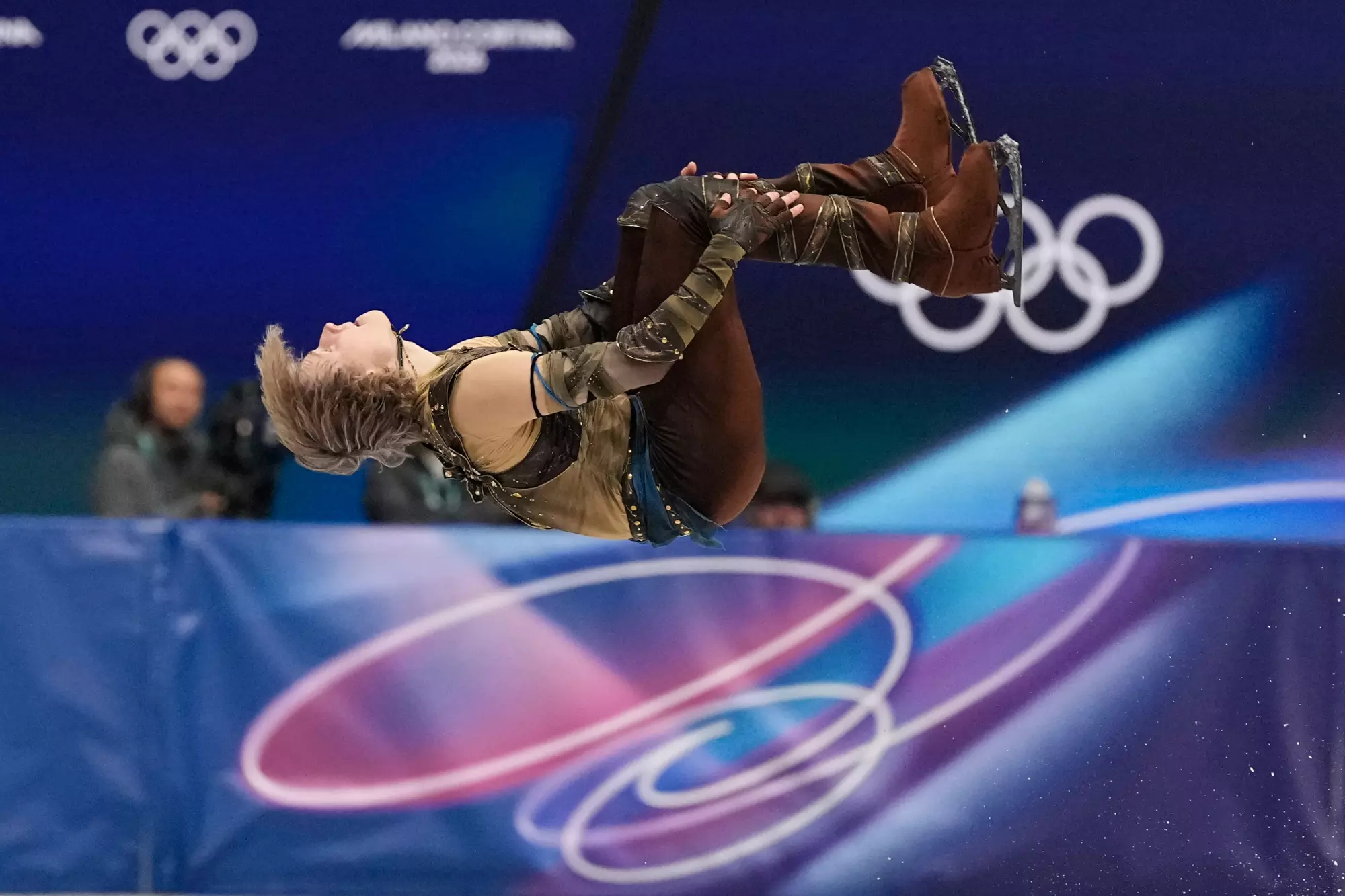
- Ilia Malinin’s backflips draw the most response from crowds even if his jumps impress the judges more.
- The backflip could be the move that helps figure skating gain more popularity outside the Olympics.
- Banned in 1976, the backflip was finally legalized by the ISU again in 2024.
MILAN — Tennis superstar Novak Djokovic jumped out of his seat. He put both hands on his head. His mouth hung open in disbelief.
Ilia Malinin leaves even the greatest athletes of all time in awe.
While Malinin is known as the only figure skater to have performed a quad axel in competition, the 21-year-old “Quad God” is turning more heads and earning more cheers for the first legal backflips on Olympic ice in almost 50 years. With a mission to break figure skating out of the four-year popularity cycle, the display of breathtaking athleticism could be a more powerful tool than any of Malinin’s quadruple-twisting jumps.
“I think it’s really something that’s really bringing back the popularity of the sport,” said Malinin, who is skating to win the men’s singles gold medal during Friday’s free skate, “because the backflip is something that I’m sure a lot of people know, just the basics of what it really is. So I think just having that really just can bring in the non-figure skating crowd.”

While figure skating remains the most popular Winter Olympic sport, efforts have been made to modernize the sport. The International Skating Union eliminated compulsory figures — the circular patterns skaters traced across the ice to display mastery of basic techniques and turns — in 1990. Music with lyrics was approved in 2014, opening the door for more contemporary songs. The ISU lifted a nearly 50-year ban on “somersault type jumps” in 2024.
Long Beach native Terry Kubicka performed the first backflip in the Olympics in 1976, but the ISU banned it swiftly after. The move was deemed too dangerous. The skill was most famously executed by France’s Surya Bonaly at the 1998 Nagano Olympics. Skating through an injury and out of medal contention after a fall earlier in her free skate, Bonaly suddenly inserted the flip in the middle of her program. The former elite trampoline gymnast put an elegant flair on the skill, splitting her legs in the air and landing on one skate.
The crowd gasped and clapped louder than at any other point of her program.
Bonaly told the Associated Press this week it was great to see the backflip return to the Olympics because skating needs to be taken to a higher level.
Decades after her iconic moment, Bonaly’s flip is talked about as an act of defiance by one of the few Black skaters in a predominantly white sport. She saluted the fans before acknowledging the judges after her program.
Regarding the criticism she received during her career, Bonaly told the Associated Press she was “born too early.”
“I broke ice for other skaters,” Bonaly told the AP. “Now everything is different. People welcome anyone as long as they are good and that is what life is about.”

A year after his parents were killed in a plane crash, Maxim Naumov delivered a strong men’s short program at the Winter Olympics in their honor.
Skaters continued to perform the daring skill in exhibition performances. France’s Adam Siao Him Fa brought the illegal maneuver back to competition at the European championships and world championships in 2024. With the modern scoring system that allows skaters to accumulate up to a dozen points for a single jump, Siao Him Fa easily absorbed the two-point deduction for the flip. He won his second consecutive European title and took bronze at worlds. The ISU lifted the ban three months later.
Malinin put the flip into his competitive program the next season.
With a gymnastics background himself, Malinin already felt comfortable with going upside down. He had mastered the flip on the ground, but translating it to ice was a different story.
“It was like just that mental barrier of getting over it,” Malinin said.
It was only about two years ago that he was able to execute the flip confidently on ice, Malinin said. He enlisted help from other skaters through social media, asking for advice. Michael Weiss, a two-time Olympian who performed a backflip with a full twist during exhibition shows, offered tips to his fellow Virginia-area native. Now flinging himself head-over-heels feels as simple as a single jump, Malinin said.
The flip is the emotional and physical high point of his program that earns the loudest applause from fans. But to the judges, it isn’t worth any additional technical points.
The ISU categorizes somersault-like jumps as “choreographic elements.” They can contribute to the program’s component score, which grades overall presentation based on competition, presentation and skating skills.
To Malinin, it’s still worth the effort.

The two-time world champion is simply fearless, choreographer Shae-Lynn Bourne said. Malinin’s willingness to take risks opens the door to more possibilities, said Bourne, a three-time Olympic ice dancer for Canada. But it also creates more chances for mistakes.
Everything Malinin does, from the flip, to his quad jumps to even some of his tricky footwork, is an opportunity to slip. With the pressure of an Olympic year, Bourne doesn’t want to expose Malinin to unnecessary mistakes. But they both want to preserve each program’s entertainment value.
“It’s finding that balance,” Bourne said. “... It’s like controlled chaos.”
The reaction, however, is pure chaos.
“Once I do that backflip, everyone’s screaming for joy,” Malinin said. “They’re just out of control.”

Chloe Kim, once the fresh-faced star of snowboarding halfpipe is now the veteran of the sport. Can the Torrance native win a third consecutive gold medal?


