Raman’s victory was a resounding rebuke to L.A.’s Latino political establishment
-
Click here to listen to this article - Share via
See more from the L.A. Times in Google Search. Set us as preferred
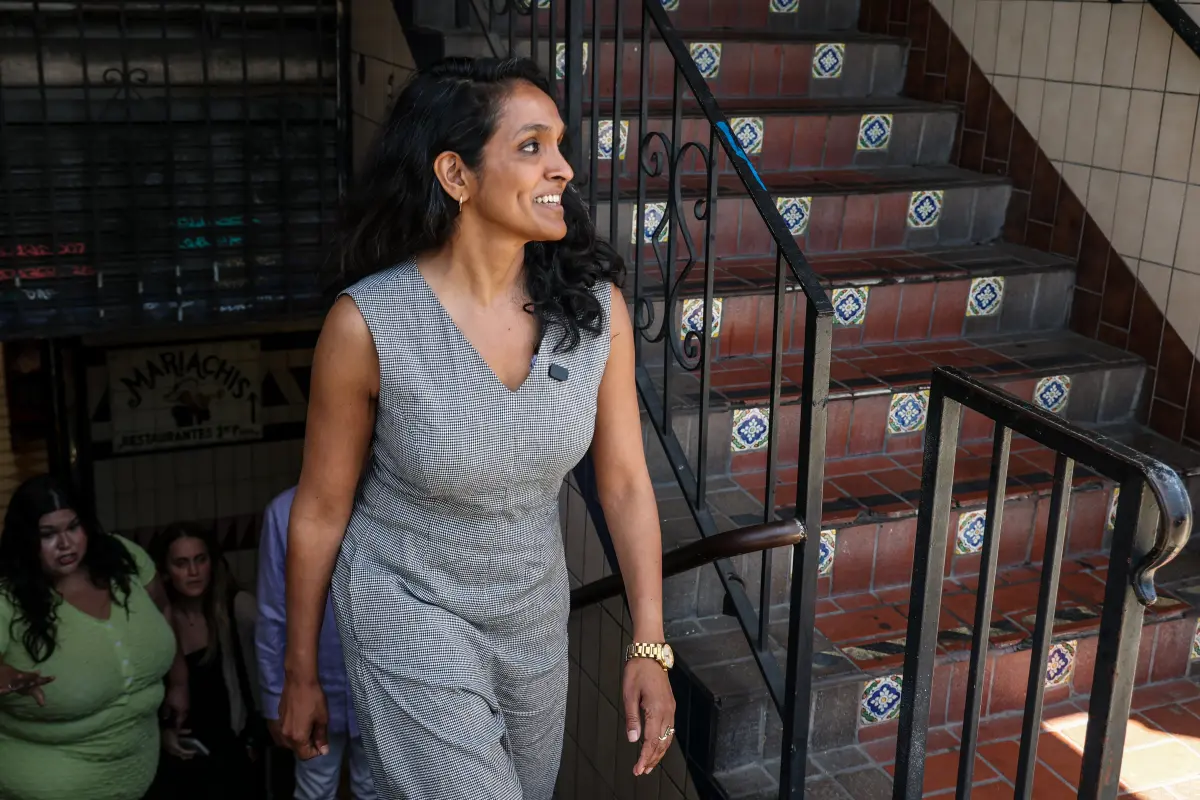
When Angelenos chose Nithya Raman as their next mayor, Karen Bass wasn’t the only establishment pillar that was resoundingly rebuked.
Here in the country’s Latino capital, the metropolis that delivered California its first Latino U.S. senator and pioneered the type of winning political machine that Latinos across the country replicated for decades, almost all the city’s Latino power brokers — politicians, nonprofit leaders, union activists, celebrities — bet big on longtime ally Bass, only to now find themselves on the outside looking in.
All that might and hype delivered worse than nada for Bass, who finished first in the June primary thanks in part to Latino support, winning 35 Latino-majority neighborhoods compared with just seven for Raman. The reverse happened in last week’s general election, with Raman winning many of the city’s key Latino neighborhoods — South L.A. to the Eastside, Pico-Union to Wilmington — according to a Times analysis of early election returns.
It was a fitting dénouement to Mayor Bass’ one term in office, and the capstone of a terrible four-year run for L.A.’s Latino political establishment, beginning with the leak of a profane, racist conversation that disgraced four top politicos.
Bass should have run as far away as possible from our caudillos y caudillas. But she just couldn’t quit them. Take an Oct. 24 lunchtime rally at Plaza Del Valle in Panorama City, the nexus for the fabled San Fernando Valley Latino political machine.
Volunteers handed out “Latinos Con Bass” signs to customers and store owners. An all-star roster of elected officials — City Councilmembers Monica Rodriguez and Imelda Padilla, Assemblymember Celeste Rodriguez (no relation to Monica) and Rep. Luz Rivas — gathered in a community room to make the case that Bass was the best choice.

Inside the rise and of an L.A. political dynasty worthy of the British royals.
“You have tías and cousins and primos that call you, ‘Who should I vote for? What do I do? How do I fill out the ballot?’” Rivas told a crowd of about 60, most of whom were not Latino. “You need to remind them Mayor Karen Bass is the right leader.”
“This is where we win elections,” Rodriguez asserted, describing the mayor — whom she bitterly opposed until fellow Councilmember Raman entered the race — as a “Valley girl” and the election as “our moment.”
The enthusiasm level struggled to exceed that of a line at the DMV. Half an hour later and a few miles east in Sylmar, a very different scene was unfolding.
A DJ blasted quinceañera classics like Marc Anthony’s “Vivir mi Vida” and “Come On Let’s Go” by Pacoima native Ritchie Valens as Raman’s team hosted a canvasada — free tacos for everyone to fuel an afternoon of canvassing. L.A. Unified school board member Kelly Gonez was the only elected official at the Carpenters Local 818 training center. The others were union members, Latino hipsters or kids too young to vote.
“Her passion to protect our community — that compassion resonated with me,” said Danny Guerrero, a 21-year-old Cal State Northridge political science major who helps undocumented college students at his school’s Dream Center. “I advocate for that in my life, and I see Nithya doing that. She meets us where we’re at.”
Guerrero cheered as Raman kicked off her remarks with an “¡Hola, Sylmar!,” pronouncing the “y” like an “i” the way a Spanish speaker would. The candidate shouted out Latino Valley icons like Lenchita’s, Tia Chucha’s Centro Cultural and even Plaza Del Valle. But she received the biggest cheers when she said, “La comunidad latina merece más.”
Latinos deserve more.
Which candidate won the most Latino neighborhoods won’t be known until the end of the month. But according to early returns with about two-thirds of the votes counted, Raman captured most of the precincts in Padilla’s and Rodriguez’s districts even after the two council members whacked away at her through the election like brats hogging the piñata stick at a birthday party.
Without institutional support, Raman focused on a new generation of Latino leaders who are not part of L.A.’s traditional political machines.
“Maybe they [Latino establishment leaders] felt obligated to back her,” Rocío Rivas said of Bass. The L.A. Unified school board member and democratic socialist endorsed Raman and attended her election night party at the Greek Theatre, where a crowd of hundreds chanted, “Sí se puede.”
“Or maybe they’re not as connected to the community as they once were,” Rivas added.
The trouble for the establishment started in 2022 when three City Council members and a powerful union leader became pariahs after starring in the audio leak scandal. That same year, democratic socialist upstarts Hugo Soto-Martínez and Eunisses Hernandez won City Council seats, despite a lack of support from Chicanosauruses who mocked their chances.

The recording that exposed the quartet’s machinations ultimately destroyed the type of ethnic politicking that made the careers of too many self-serving power grabbers. The transcript of their back-and-forth now reads as prophecy.
In January 2024, former City Councilmember Jose Huizar — once a rising star with aspirations for higher office — was sentenced to 13 years in prison after pleading guilty to corruption charges. In the fall of that year, Eastside Assembly and City Council seats held by Latinos for decades went to Filipina Americans Jessica Caloza and Ysabel Jurado. Meanwhile, former Mayor Antonio Villaraigosa’s campaign for governor sputtered out with just 1% of the vote.
In the race to succeed Nury Martinez, who resigned from the City Council after the audio leak, Padilla won in 2023 with backing from the Valley Latino political machine.
Marco Santana lost to Padilla in the primary. despite an endorsement from Raman, and supported Raman’s mayoral campaign.
“The mayor ran on a very institutional playbook of getting a bunch of Latino politicians together so they could tell Latinos how to vote,” said Santana, 36. “That doesn’t work anymore. Latinos want deeds.”
Instead, outdated ideas were all Bass had.
It started with her choice of chief campaign strategist: Julie Chavez Rodriguez, who was campaign manager for President Biden’s disastrous 2024 reelection bid and then Kamala Harris’ failed attempt to pick up the pieces. I quickly tuned out the one time Chavez Rodriguez described her vision for Latino outreach, which would have been revolutionary in L.A. two generations ago.
While Bass’ campaign mounted a vigorous media outreach effort in English and Spanish, her own attempts to court Latino voters kept backfiring. The crowd at the annual City Hall Mexican Independence Day celebration booed when Padilla, in a green outfit that matched Bass’, hailed the mayor as “good.”
At Homegirl Cafe in Chinatown the morning before the election, customers largely ignored Bass while swarming gubernatorial candidate Xavier Becerra. She stood next to Becerra at the restaurant, only to have him later clarify to reporters that he wasn’t endorsing anyone in the mayor’s race.
Michael Trujillo is a longtime political consultant who served as an unpaid advisor to a pro-Bass independent expenditure committee and has participated in the rise and struggles of the Eastside and San Fernando Valley machines.
“It’s going to take a long time” for L.A.’s Latino political establishment “to be reconstructed, and that’s ironic when you have Latinos in charge in Sacramento now,” he said. But he predicted that Raman would bear her former opponents no ill will, because “they’re going to give her a fair shot” — because what else can they do?
The Raman era will undoubtedly boost a new generation of Latino leaders. But establishments don’t fade away so easily — and insurgents don’t automatically shun them.
On Saturday, Raman attended a news conference to condemn the arrests of two people by federal immigration agents during an anti-ICE protest outside Adventist Health White Memorial Center. The mayor-elect shook the hands of state Sen. Maria Elena Durazo, SEIU California President David Huerta and Angelica Salas, executive director of the Coalition for Humane Immigrant Rights of Los Angeles, all of whom endorsed Bass and recorded social media videos in support of the incumbent.
When it was Raman’s turn to speak, she led the crowd in chants of “ICE out of Boyle Heights” and praised Huerta, Durazo and Salas. Raman concluded by promising Angelenos in Spanish that she would “defend” immigrants.
And then L.A.’s Latino political establishment did the only thing they could: They applauded.


Insights
L.A. Times Insights delivers AI-generated analysis on Voices content to offer all points of view. Insights does not appear on any news articles.
Viewpoint
Perspectives
The following AI-generated content is powered by Perplexity. The Los Angeles Times editorial staff does not create or edit the content.
Ideas expressed in the piece
- The article argues that Nithya Raman’s victory was a rebuke not only to Karen Bass but also to Los Angeles’ traditional Latino political establishment, whose elected officials, labor leaders and community figures largely backed Bass. It contrasts that institutional show of support with Raman’s success in Latino-majority neighborhoods.
- In the article’s view, traditional leaders misjudged how much their endorsements could sway voters. Gustavo Arellano contends that many Latinos—especially younger voters—wanted tangible results and a candidate who connected with their concerns, rather than political figures telling them whom to support.
- The piece presents Raman’s grassroots outreach as a contrast to the establishment’s approach: she courted Latino voters in Spanish and built support among younger organizers and community members. Other campaign reporting likewise describes a focused effort to reach Latino voters through Spanish-language events and creators, alongside messages on affordability, housing and homelessness.[1]
- The article places the election in a longer decline for the old political networks, citing the City Hall audio-leak scandal, corruption convictions and losses by establishment-backed candidates. It nevertheless cautions that the establishment may adapt rather than disappear, pointing to Raman’s later public alliance with immigrant-rights leaders who had endorsed Bass.
Different views on the topic
- Other accounts interpret Raman’s win as part of a broader anti-establishment and anti-incumbent vote, rather than primarily a rejection of Latino political leaders. Political observers cited by the Daily News pointed to dissatisfaction with Bass’s performance and the strength of a younger, progressive coalition as major factors.[3]
- Raman’s Latino support may also reflect effective campaign work, not simply a repudiation of established leaders. Reporting describes her team’s targeted Latino outreach and a shift in likely Latino voter support during the runoff.[1]
- Bass and her allies offered a contrasting case: Bass questioned Raman’s readiness to lead, while campaign criticism focused on Raman’s positions and record. A separate account of the race reports concerns raised by Bass about Raman’s relationships with colleagues and policy shifts.[2][5]
- Raman’s victory did not erase the institutional influence of the groups that backed Bass. The mayor-elect will have to govern with a City Council whose members largely supported Bass, as well as labor and other organized interests that opposed Raman during the campaign.[4]

More From the Los Angeles Times


Podcasts

William Mulholland was the water boss who made L.A. possible. His reputation gave him unchecked authority as a dam builder. In 1928, that led to one of America’s deadliest disasters--and the question of whether it was a crime.

It started as a ploy to scare Texas out of redrawing its congressional map and ended with California voters approving a new map of their own, one that could hat could help alter the balance of power in Washington.

On this week’s episode of Boiling Point, Miranda Green speaks with Los Angeles Times climate reporter Hayley Smith about how AI bots are meddling in California’s clean energy policymaking.


