Search

Items tagged with: translation


Back in the days, before COVID, a good chunk of my income came from going abroad to teach - mostly German, sometimes English.

I’d be hired by an organisation or a business, pack my things, and then live somewhere else for a few months, organising and teaching classes. Designing my own curriculum. Working with my students to achieve their goals.

My personal record for continuous hotel living? 93 days. 🏨😄
And honestly? I loved it.

I loved arriving somewhere new and slowly getting to know the place. The people. The little routines. The cafés. The weirdly different supermarket products. The things you only notice when you actually live somewhere for a while.

And I loved returning to places I had already grown fond of.

Alas, those jobs seem to have disappeared. Some of the work moved online, and apparently the demand for these courses has declined quite a bit.

But I miss it.

If someone offered me the chance tomorrow to pack a suitcase, board a train or plane, and go teach German somewhere for a few months?

I’d say yes before they even finished the sentence. ❤️

Some kinds of work are also adventures. I think I miss that part most.

#Teaching #LanguageTeaching #Languages #Translation #TeachingAbroad #WorkAbroad #Travel #HumanConnection


Mastodon has an optional translation system to translate posts in languages that you don't speak. To use it, just click on "Translate" below a post (on some apps the translate option may be in the post's ⋯ menu).

I've tried to answer common questions about Mastodon's translation feature in this guide:

➡️ fedi.tips/is-there-a-built-in-…

Let me know in the replies if I've missed your question.

#FediTips #Mastodon #Translation


The media in this post is not displayed to visitors. To view it, please go to the original post.

Update: One of the admins of this Facebook group apparently deleted all comments by myself and other authors who expressed criticism of this approach.

One admin of this group also posted assorted comments which were strongly in favor of AI translation, since "all the big publishing houses are doing this".

🤨

#amwriting #translation


The media in this post is not displayed to visitors. To view it, please go to the original post.

The Errant Translator: Field Notes

Artist and translator Sawako Nakayasu considers a multiplicity of approaches to translations.

wordswithoutborders.org/read/a…

Books about French fiction -- Translations into English at PG:
gutenberg.org/ebooks/subject/5…

#books #literature #translation


Both the zine and the invitation page have been translated to several languages already, and I would love to add more!

github.com/jointhefediverse-ne…

github.com/stefanbohacek/fediv…

#fediverse #translation #localization #volunteer


The media in this post is not displayed to visitors. To view it, please go to the original post.

Seit ziemlich genau 10 Jahren bin ich Autorin. Grund genug, zurückzuschauen und Revue passieren zu lassen, was literarisch so alles passiert ist.
Als 4. Roman veröffentlichte ich „Pantopia“ bei Fischer Tor.

#lookingback #10jahre #pantopia #kommnachpantopia #literatur #autorinnenleben #phantastikpreis #seraph #klp #dsfp #fuerstenfeldbruck #bookstagrammers #booktok #utopia #utopie #scienefiction #sf #climatefiction #future #translation


After their informative, witty and insightful conversation on stage, audience questions were invited. A middle-aged man asked the author: ”In future, would you not use AI language machines to translate your books instead?"

I take heart from the fact that a negative reaction instantly flew through the room. People gasped. One man literally booed. Many groaned and mumbled. One person may or may not have said OhForFucksSake aloud. That person may or may not have been me.

#AI
#Books
#Translation


The media in this post is not displayed to visitors. To view it, please go to the original post.

Lucas Ruiz wrote a book in his native Spanish. Professional translator Ditte Brand translated it into Danish. She interviewed him at LiteratureXchange Aarhus Literary Festival. They happen to be married. This made the conversation about writing & translation even more interesting & entertaining. They live in Denmark. He speaks Danish. They discussed translation & editorial issues along the way but he chose not to read the final translated work as a whole. That is hers.

#Books #LitX #Translation


The media in this post is not displayed to visitors. To view it, please go to the original post.

Why I refuse to use Machine Translation

In the last few years, there has been a lot of talk about how artificial intelligence (actually: commercial chatbots and LLMs) will be transforming our way of working – how it will make some jobs more efficient, and others obsolete. There are also concerns that such systems do not live up to the hype – though this has not stopped CEO and their consultants from pushing them into the workplace, in the hopes of drastically reducing their work force and labor costs even though they cannot substitute for their workers’ process knowledge.

I translate old German folk tales into English, and translation work is already heavily automated these days due to the sheer amount of material that needs to be translated. Thus, it is unsurprising that many people have asked me whether I use machine translation for my work – usually with the assumption that this would save me time.

In this essay, I am going to tell you why I won’t use AI systems for my translation work. I could talk about the ethical concerns – how the work of others is used to train LLM systems without compensation while charging for their output, or how they consume massive amounts of electricity and other resources while our planet and its ecosystems are already on the precipice, or how they are used to build up the mother of all investment bubbles.

I could also add some personal grievances. For instance, in my day job as a bid manager, I also have to price server systems for our customers, and when I recently noticed that a simple 16 GB DDR5 RAM module had a purchase price of €1,600, I realized that something is going very wrong indeed. Furthermore, anonymous bot networks are constantly scraping my websites for LLM training data, forcing me to upgrade my website hosting plan twice last fall to keep outages at a tolerable level.

But since others have elaborated on the ethical concerns in much more detail than I ever could, I won’t be talking about these further. Instead, I will be discussing the practical reasons why machine translation does not fit into my working processes when translating German folk tales.

Reading the Fraktur Typeset


The first challenge for machine translation is parsing the source material. For copyright reasons, I exclusively use public domain works – German folk tale collections which were largely published in the 19th century. And the vast majority of these works were not printed with the modern Antiqua letters, but the old German Fraktur typeset. Here is a reasonably “clean” example of a story I have translated (the source page is here):
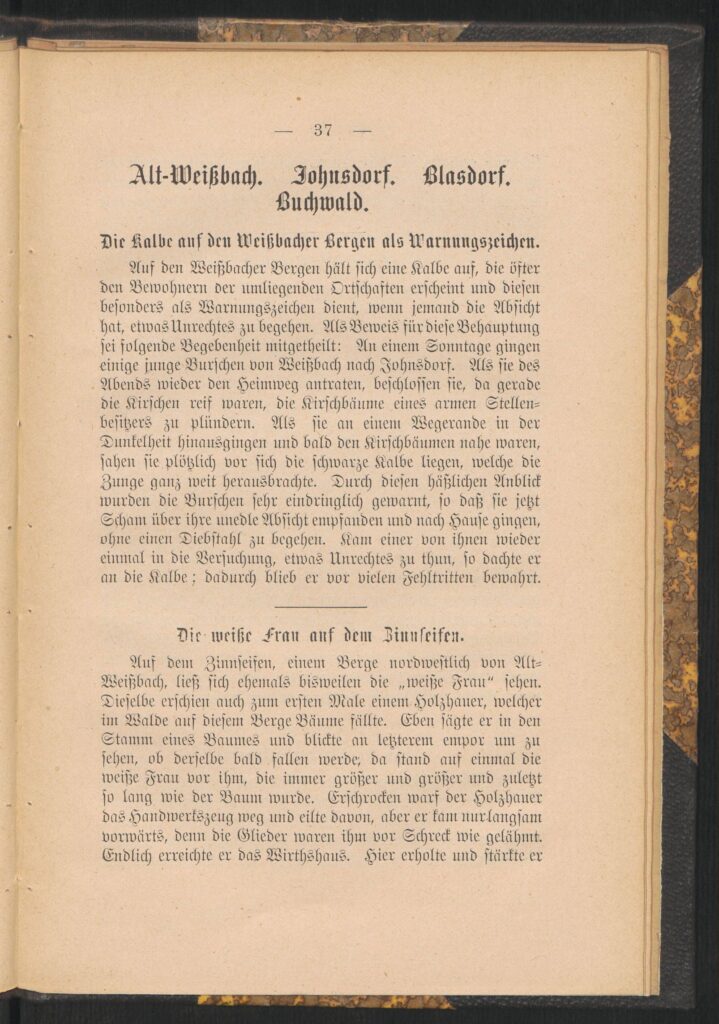
A page from an old German collection of folk tales, written in the Fraktur typeset. It features the tale "Die Kalbe auf dem Weißbacher Bergen als Warnungszeichen".
Usually, texts that are converted into a new language by machine translation are already in a machine-readable format – but these old digital scans are not. Thus, before I could use machine translations for these texts, I would need to convert them into a machine-readable format. While OCR (“Optical Character Recognition”) tools exist that can handle Fraktur typesets, the output would require additional effort for proofreading, especially since the input data is highly variable in its quality.

Thus, in contrast to the original premise, machine translation would actually increase my workload even before I got to the actual translation step.

Translating Old Words and Phrases


LLM systems are largely trained on the most commonly available modern texts (such as Reddit posts). 19th century German folk tales are not “modern texts”. They are rife with old words and phrases that were only used in some small geographical area and are no longer in modern use. Would a standard machine translation system (i.e., one trained on Reddit) come up with a decent translation for “Bindelbaum” – to pick just one example that stuck in my mind? Especially considering that the old texts that could provide some context were not in a machine-readable format, and thus of limited use for training the LLMs?

Perhaps they could, and perhaps they couldn’t. However, “maybe this is an accurate translation” is not good enough for my purposes, and indeed, it is not sufficient for any professional translator. If I provide a translation for certain old words and prices, I need to be as sure as possible that this translation is accurate – and if I am uncertain, I need to explain that to my readers as well.

Thus, I would have to double-check every machine-translated text I work with with my own research – which, again, would not save me any time. And if I am doing all the research anyway, I might as well skip the machine translation and do it all by myself in the first place.

Providing Context


But truth to be told, the actual translation is the easiest part of my work. German folk tales were told in a specific time and a specific cultural context. The original audience for these tales (mostly 19th century German peasants) were deeply familiar with this context.

A modern audience will usually not be familiar with this context. Many aspects of these folk tales are hard to grasp even for modern Germans – so what chance does an international audience have?

This is why one of my most important tasks as a translator is to explain this context. This is why my books have many hundreds of footnotes, and explanatory commentary following each tale. While I am not primarily writing my books as scientific treatises, I have spent enough years in academia that I have views on providing inaccurate information. Sure, mistakes can and will happen. But allowing errors to proliferate in my manuscripts because I was outsourcing the most critical aspects of my research to LLM systems would be a gross violation of ethical standards (not that this seems to stop a lot of LLM users…).

So I will do my research the proper way. And with each paragraph I translate, I contemplate its hidden meanings and context, and how to convey it to my readers. But if I don’t do the first step of the work myself – that is, translating and thinking about every single sentence – then I have already lost my first opportunity to truly understand the story.

Preserving Unique Voices


German folk tales were told by tens of thousands of people, each of whom had their own unique way of telling their stories. And later on, they were collected by hundreds of folklore researchers, each of whom had their own unique editorial approach. That adds up to a lot of unique voices.

However, LLMs are well-known to generate texts that trend towards the average. They have been trained on vast archives of human-written texts, and their task is to create texts that are “most likely” to fit the prompt – the common denominator, if you will. Worse, it will be the most common denominator of Reddit users and the like. The only LLM system that might even come even close to capturing the unique voices of the original texts would be one that has been trained exclusively on their translations – including my translations.

While I want people to be entertained by my translations, these tales are also part of my country’s cultural heritage. Not even trying to capture the unique voices of these long-ago storytellers and instead replacing them with the generic output of LLMs feels hugely disrespectful.

They deserve better, and my audience deserves better as well.

#LLM #MachineTranslation #Translation


English speakers of the fedi. In a software with the interface in English, Reading a menu with verbs such as Save, Open, Close, Edit, Format etc., do you read them as imperative (an order: "do this") or as an infinitive (the "base form" of the verb, like "to do this")?

Are you a native speaker or have English as a second language?

#Dev #ux #ui #software #interface #translation #uiux #uxui #gui

  • Native speaker, imperative (25%, 656 votes)
  • Native speaker, infinitve (18%, 465 votes)
  • Second Language, imperative (20%, 534 votes)
  • Second Language, infinitive (35%, 900 votes)
2555 voters. Poll end: Wednesday, March 18, 2026, 3:59 AM


Nutzt wer Fedilab mit Deepl API Key? Bei mir funktioniert die Übersetzung nicht mehr. Bekomme nur eine Fehlermeldung und leeres Übersetzungsfeld. 😕

#fedilab #deepl #translation


Ich konnte doch mal über Mastodon im Browser fremdsprachige Posts übersetzen lassen oder hab ich mir das eingebildet und das war nur in Tusky auf Android möglich? 🤔

Ist eigentlich ein nützliches Feature, welches das babylonische Sprachengewirr etwas lichtet.

Eigentlich könnte jede und jeder damit in der eigenen Sprache Posts kommentieren und Doppelposts in verschiedenen Sprachen wären überflüssig...

#Fediverse #Mastodon #Tusky #Translation


The media in this post is not displayed to visitors. To view it, please go to the original post.

Practical Translation: Proust

A panel discussion moderated by Merve Emre

nybooks.com/online/2025/08/24/…

Marcel Proust (as an author and translator) at PG:
gutenberg.org/ebooks/author/98…

#books #literature #Translation


Die #UniMainz bietet ab Wintersemester 2025/2026 einen neuen Bachelorstudiengang für Sprachbegeisterte an, die sich für professionelles mehrsprachiges Handeln in transkulturellen Kontexten in mind. zwei und bis zu fünf #Sprachen qualifizieren möchten 👉 youtube.com/watch?v=iQf64VSbOq…

Alle Infos unter 👉 fb06.uni-mainz.de/uebersetzen-…

#FTSKUniMainz #AbiUndDann #Studieren #Bachelor #Sprachen #Übersetzen #Dolmetschen #Translation #Kultur #Kommunikation #UniMainz


My #review of 𝑇ℎ𝑒 #𝐵𝑜𝑜𝑘 𝑜𝑓 #𝐵𝑒𝑖𝑗𝑖𝑛𝑔
@commapress, 2023).

"The volume showcases ten important #writers and ten assured translators."

"In ten #stories, 𝑇ℎ𝑒 𝐵𝑜𝑜𝑘 𝑜𝑓 𝐵𝑒𝑖𝑗𝑖𝑛𝑔 visits a jam-packed subway, a football stadium, an after-hours art gallery, hutongs of the Cultural Revolution era, . . . . We meet a host of characters: . . . . and their struggles reveal an often-troubled embrace of the #city."

#Chinese #literature in #translation @chineseliterature

chajournal.blog/2024/04/10/boo…


LibreTranslate is Free and Open-Source Self-hosted Machine Translation


The media in this post is not displayed to visitors. To view it, please go to the original post.

Webpage showing a left-side box with text in it, and on the right-side a box with translated text
LibreTranslate is a machine translation API which is entirely self-hosted. This software lets you use open source machine translation in your projects. It uses Argos Translate for its translation engine.

It supports quite a few commonly used languages, but for example, for my own country it only supports English and none of the other 10 official languages. They provide two links at the end of the review to a test site as well as the open source code project. When I tested it for English to Dutch, it did not recognise everything and showed about 95% accuracy. So not quite in Google’s league, but if you want a free and self-hosted alternative then it does do a pretty good job.

That said, to add new languages, you first need to train an Argos Translate model. They provide a video link for details. First you need to collect data, for example from Opus, then you need to add the data to data-index.json in the Argos Train repo.

I see also you can enable all languages by turning on –debug mode, which includes the non-reviewed languages too.

If you don’t want to self-host, you can also opt to use their cloud API for production use for a fee. But a docker image is available, which would make self-hosting pretty simple.

See linuxlinks.com/machine-learnin…
#Blog, #opensource, #selfhosting, #technology, #translation